
Cervical Orgasm: What It Is and What to Know
Learn about cervical orgasm, including what it is, how it differs from other types, and what you need to know about this deep internal experience.
 Zoe Clarke

Learn about cervical orgasm, what it is, and important insights for understanding this unique sexual experience.
Introduction to Cervical Orgasm
Cervical orgasm is one of those things your group chat probably has opinions about — half the people swear it's the most intense thing they've ever felt, the other half aren't sure it's real. Here's the thing: both groups are right. Cervical orgasm is a real physiological response, but it's not universal, and it's wildly different from the clitoral stimulation most people are familiar with.
The cervix sits at the top of the vaginal canal, where it meets the uterus. When stimulated — usually through deep penetration or specific angles during sex — some people report a full-body orgasm that feels different from what happens when the external clitoris gets attention. Research shows that cervical stimulation activates different nerve pathways, including the vagus nerve, which can trigger orgasm even in people with spinal cord injuries. That's not a metaphor — it's a completely separate neurological route to pleasure.
What Makes Cervical Orgasm Different
Most orgasms people talk about involve the clitoris, which has over 8,000 nerve endings and is the most concentrated pleasure zone in the body. Cervical orgasms work differently. They're deeper, often described as more intense or "whole-body," and they take longer to build. The sensations aren't localized the same way — instead of a focused peak, people report waves of pleasure that radiate outward.
The cervix itself has fewer nerve endings than the clitoris, but the ones it has connect to a different part of the nervous system. That's why some people find cervical stimulation uncomfortable or even painful, while others find it intensely pleasurable. It's not about doing it wrong — it's about individual anatomy and where your sensory thresholds sit.
The other key difference: cervical orgasms don't happen in isolation. Most people who experience them report that they're already highly aroused, often from clitoral or other stimulation first. The cervical orgasm becomes an additional layer, not a replacement. Sexual response is cumulative — the more pathways you activate, the more intense the overall experience can be.
Understanding cervical orgasm matters because it challenges the idea that there's one "right" way to orgasm. Some people never experience it and don't need to. Others find it only happens with specific partners, toys, or positions. The point isn't to chase it as a goal — it's to understand that sexual pleasure has multiple entry points, and the cervix is one of them.
Understanding the Problem: Misconceptions About Cervical Orgasm
The biggest misconception about cervical orgasm is that it doesn't exist — or that it's just another way of saying "deep vaginal stimulation" without any real distinction. Most sex ed skips it entirely, and even good beginner guides treat the cervix like a pain point to avoid rather than a potential source of pleasure. That's partly because for a lot of people, cervical contact is uncomfortable or outright painful. But dismissing the possibility altogether means a chunk of people never learn that their anatomy might respond differently.
Another common myth: cervical orgasm is the same thing as a G-spot orgasm, just deeper. The two involve different nerve pathways. The internal clitoris wraps around the vaginal canal and responds to pressure from the front wall — that's the G-spot cluster. The cervix, by contrast, sits at the end of the vaginal canal and may involve the vagus nerve, which is a completely different sensory route. Research has shown that people with complete spinal cord injuries — who have no sensation below the waist through traditional spinal pathways — can still experience orgasm from cervical stimulation, suggesting the cervix has its own neurological wiring.
The "clitoral versus vaginal orgasm" debate muddies the water even more. For decades, the conversation treated these as mutually exclusive camps, with cervical stimulation lumped in as a footnote or dismissed as pseudoscience. The reality is messier: the clitoris has both external and internal structures, the vaginal canal has multiple sensitive zones, and the cervix is its own thing. They're not competing — they're just different inputs that some bodies register as distinct types of pleasure.
The last big misconception: that cervical orgasm requires a specific toy or a partner with a long penis. Depth matters less than angle, pressure, and timing. Plenty of people explore this with average-length toys or fingers during high arousal when the cervix changes position. The issue isn't access — it's knowing it's even an option and having accurate information about how to try it safely.
Steps to Explore Cervical Orgasm
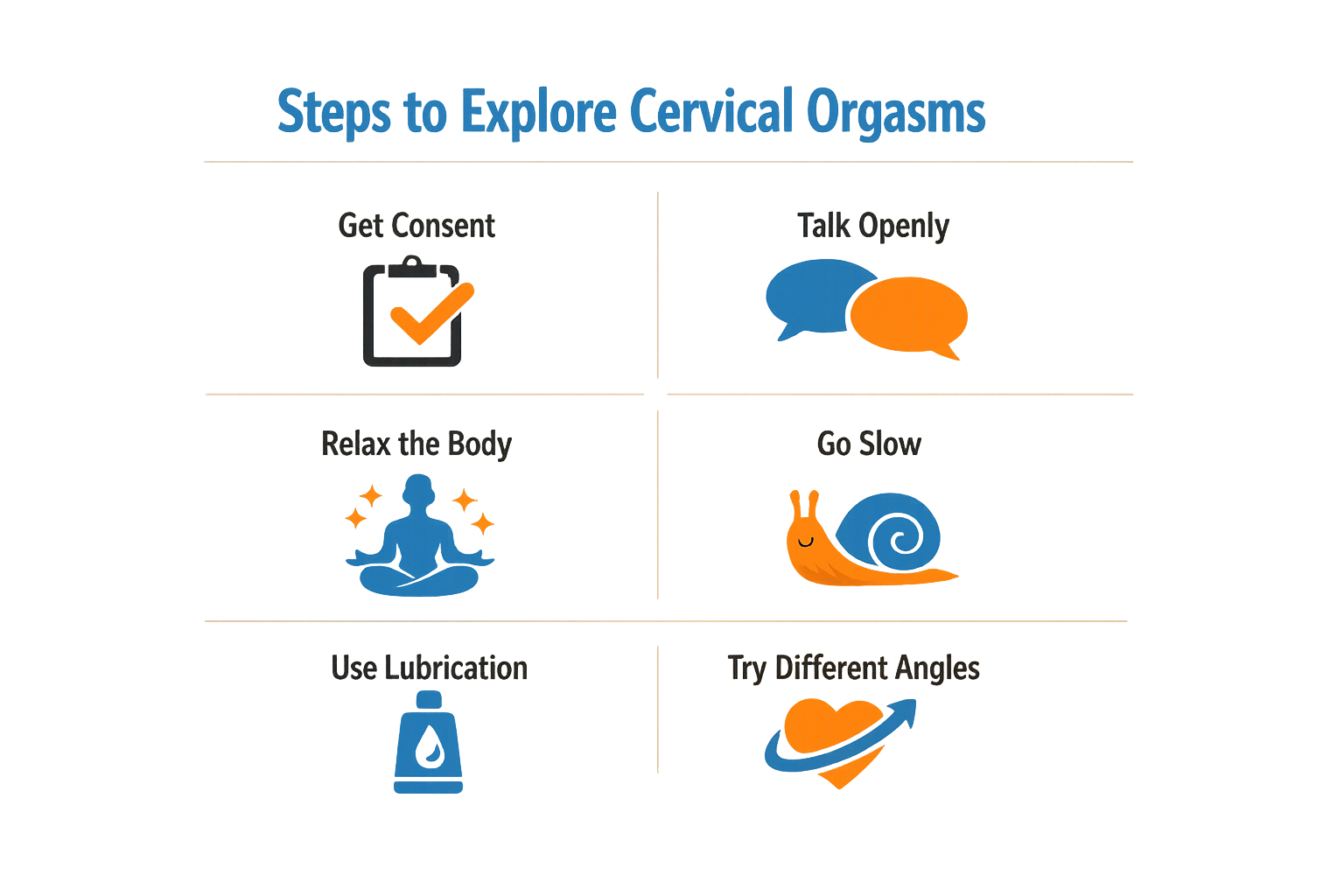
The cervix isn't a one-and-done target — it's a process. Most people who've experienced cervical orgasm describe it as something they built up to over time, not something that happened by accident during one random hookup. Here's the honest roadmap.
The cervix changes position and sensitivity depending on arousal level. When you're not aroused, it sits lower and can feel uncomfortable or even painful when touched. As arousal builds, it lifts and the vaginal canal lengthens, making deeper stimulation more comfortable. Spend time on other forms of stimulation first — clitoral, vulvar, whatever works for you. Don't rush straight to deep penetration.
You need to know where your cervix actually is. Insert a finger (or have a partner do it) and feel for a firm, rounded surface at the end of the vaginal canal — it feels different from the surrounding tissue, kind of like the tip of your nose. Note where it is, how it responds to light pressure, and whether it feels sensitive or neutral. This isn't about forcing sensation; it's about gathering information.
Cervical stimulation requires depth and often a specific angle. For solo exploration, a longer dildo or vibrator designed for internal stimulation works better than a short bullet vibe. For partnered sex, positions like missionary with legs elevated, doggy style, or lying on your stomach tend to allow deeper penetration. The goal is contact, not force — if it hurts, stop and adjust.
Cervical orgasm doesn't respond well to jackhammer thrusting. Use slow, deliberate movements with consistent pressure against the cervix. Some people describe a rocking or grinding motion as more effective than in-and-out thrusting. This is where the learned aspect comes in — your body needs time to associate this type of stimulation with pleasure, not discomfort.
Most people who report cervical orgasms say they don't happen in isolation. Clitoral stimulation, nipple stimulation, or even mental arousal from fantasy all contribute to the overall experience. The cervix may be the focal point, but the rest of your nervous system is still involved. Don't treat it like a isolated button — treat it like one part of a larger sensory map.
The research on this is clear: cervical stimulation can trigger orgasm through a distinct neural pathway, but that doesn't mean it will for everyone, or that it should. Your job is to explore what your body responds to, not to force a specific outcome because the internet said it's possible.
Tips and Tricks for Achieving Cervical Orgasm
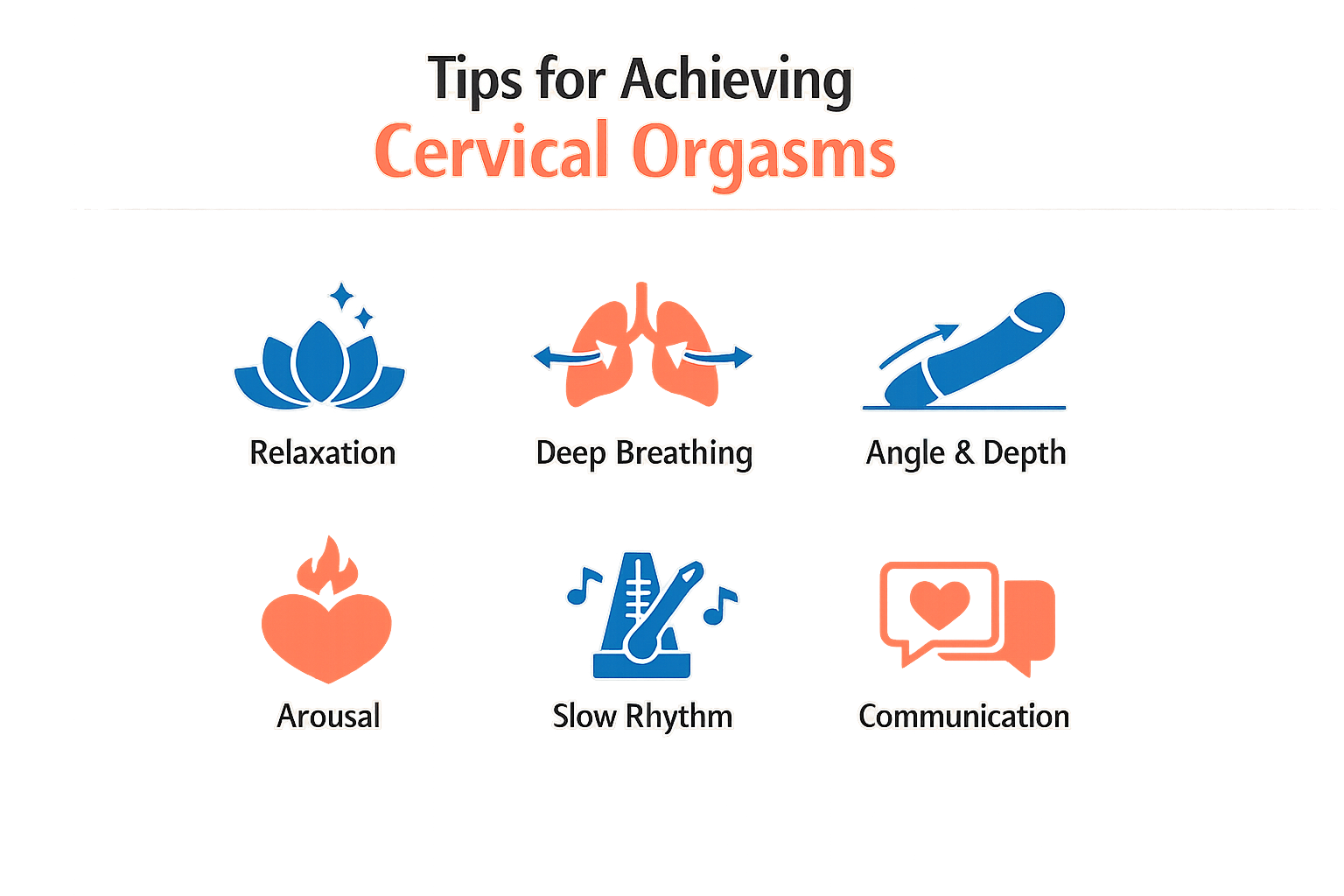
The thing about cervical orgasms is that they're not a checklist you complete — they're more like a skill you develop. Most people who experience them didn't get there on the first try, and that's completely normal. What works comes down to a combination of positioning, arousal level, and honestly just knowing your own body well enough to recognize what deep stimulation feels like when it's working.
Start with High Arousal
Cervical stimulation when you're not already turned on can feel uncomfortable or even painful. The cervix shifts position during arousal — it actually lifts and pulls back slightly as you get more aroused, which changes how accessible it is and how stimulation feels. That's why trying to go straight for deep penetration without building up first is usually a bad time.
Spend real time on external stimulation first. Clit stimulators are a solid option here because they can get you to a high arousal baseline before you even think about internal stimulation. The more aroused you are, the more your body is primed to interpret deep pressure as pleasurable rather than just pressure.
Use Positions That Allow Deep Penetration
Not all positions give you the depth or angle needed to reach the cervix. Positions where your hips are tilted — like lying on your back with a pillow under your hips, or being on top and leaning forward — tend to work better because they change the angle of the vaginal canal and make the cervix more accessible.
Doggy style and variations where you're face-down also allow for deeper penetration, but the key is control. You need to be able to adjust depth and angle in real time, which is why positions where you're in control of movement (like being on top) often work better when you're still figuring out what feels good.
Go Slow and Pay Attention to Pressure
Deep stimulation isn't about speed or force — it's about sustained, rhythmic pressure. Think slow, deliberate thrusting or a toy that stays in place and applies consistent contact. The cervix responds to pressure differently than the clitoris does; it's less about quick, intense bursts and more about building a deep, radiating sensation over time.
If you're using a toy, longer options with a curved or bulbous tip work well because they can reach the back of the vaginal canal and apply pressure without needing to be rammed in. The goal is contact, not impact.
Mastery over orgasm is part of the sexual self-knowledge and confidence that every person has a right to experience.
Experiment with Toys Designed for Depth
Dildos and internal vibrators that are at least 6–7 inches long and have some girth give you the length needed to reach the cervix comfortably. Curved toys can also work if the curve aligns with your anatomy, but straight or gently curved options tend to be more versatile for deep stimulation.
Some people find that firm toys work better because they don't compress or bend during use, which means more consistent pressure. Others prefer softer materials because they're more forgiving if you're still figuring out angles. There's no universal right answer here — it's about what your body responds to.
Communicate If You're with a Partner
If you're exploring this with a partner, you need to be able to say "deeper," "slower," "different angle," or "stop" in real time. Cervical stimulation can go from pleasurable to uncomfortable very quickly if the angle or pressure is off, and your partner can't feel what you're feeling.
Be specific. "A little to the left" or "hold it there" is more useful than vague feedback. And if something doesn't feel good, say so immediately — this isn't the kind of stimulation where you power through and hope it gets better.
Know That It Might Not Happen, and That's Fine
Not everyone's body is wired to interpret cervical stimulation as pleasurable, and that's not a failure. Some people find it uncomfortable no matter how aroused they are or what position they try, and that's just anatomy. The cervix has nerve pathways, but whether those pathways translate to orgasm varies from person to person.
If you've tried the basics — high arousal, good positioning, slow pressure — and it's still not working, you're not doing it wrong. You might just be someone whose body doesn't respond to that type of stimulation, and that's completely normal.
Conclusion: Embracing the Journey of Sexual Exploration
Cervical orgasms aren't some mythical experience reserved for the anatomically lucky — they're one of several ways your body can respond to deep internal stimulation. Some people will find them with the right position, the right toy, or the right partner. Others won't, and that's not a failure. Sexual response is individual, and what works for your group chat might not work for you.
The takeaway here is simple: your body learns what feels good through experience. Movements become automated, preferences crystallize, and over time you develop a clearer sense of what works. That process doesn't end after your first orgasm or your tenth — it evolves across your lifespan as you try new things, new positions, new contexts. Cervical stimulation is just one option in a much larger menu.
If you're curious about deep internal stimulation, start with what feels comfortable. Use lube, go slow, and pay attention to what your body is telling you. If cervical contact feels good, lean into it. If it doesn't, redirect to what does. There's no checklist to complete here, no achievement to unlock. Clit stimulation is still the most reliable path to orgasm for most people, and combining external and internal stimulation is often the approach that lands.
The research on cervical orgasms confirms they're real, they involve distinct nerve pathways, and they can feel different from clitoral or G-spot orgasms. But the science also makes it clear that orgasm is a learned, conditioned response — your brain and body work together to automate the patterns that lead to pleasure. That means the more you explore, the more refined your understanding becomes.
So if cervical orgasms are on your list, go ahead and experiment. If they're not, that's fine too. The point is to stay curious, stay open, and keep the focus on what feels good rather than what you think you're supposed to achieve.