
Water-Based vs Silicone Lube: Which to Use With Toys?
Water-Based vs Silicone Lube comparison: discover the differences between formulas to find out which is best for your toys and play style.
 Zoe Clarke

Introduction
Water-Based vs Silicone Lube isn't just a product choice — it's the difference between keeping your toys working and ruining them in a single session. The lube aisle is where most first-time toy buyers freeze up. You've got the toy sorted, you know you need lube, and then you're staring at twenty bottles with zero idea which one won't wreck your new purchase.
Here's the thing nobody puts on the bottle: the two formulas do completely different jobs, and one of them will straight-up dissolve certain toy materials. Water-based is the safe bet for nearly everything, but silicone has staying power that makes it worth the trade-offs if you know what you're doing. Most toy manufacturers default to recommending water-based — LELO's own manuals specify water-based solutions for their silicone products and warn against silicone lube making the surface permanently tacky.
The decision comes down to three factors: what your toy is made of, how long you need the lube to last, and whether you're using barriers like condoms. Get those right and the choice is obvious. For more context on how different toy types work with your anatomy, check out our guide on clit stimulators and choosing the right type.
This guide walks through the actual differences between Water-Based vs Silicone Lube, when each one makes sense, and how to avoid the mistakes that cost you a toy.
What Makes Water-Based vs Silicone Lube Different?
Most first-time buyers grab whatever lube is on the shelf without reading the label — and then wonder why their brand-new silicone toy feels tacky or starts degrading after a few uses. The problem isn't the toy. It's the lube.
Here's the thing: not all lubes work with all toys. The two most common types — water-based and silicone — have completely different compatibility rules, and nobody puts that on the front of the bottle. You're supposed to just know that silicone lube destroys silicone toys, or that water-based formulas dry out faster and need reapplication. Most beginner guides skip this part entirely, assuming you'll figure it out after you've already made the mistake.
The confusion gets worse when you factor in toy materials. Silicone toys are the most popular category (they're body-safe, easy to clean, and widely recommended), but they're also the most restrictive when it comes to lube. Water-based works with everything, but it's not always the best performer. Silicone lube lasts longer and feels slicker, but it's off-limits for most of what's in your drawer.
What most sites miss: the real issue isn't picking the "better" lube — it's knowing which one won't wreck your $80 vibrator. If you're using a clit sucker or any other silicone toy, the safe default is water-based. If you're using glass, metal, or hard plastic, silicone lube is on the table. The problem is that most people don't check the toy material before they buy the lube, and by the time they notice the texture change, the damage is done.
For more on how different stimulation types work, check out tongue vibrators and how to choose one.
How Do You Choose Between Water-Based vs Silicone Lube?
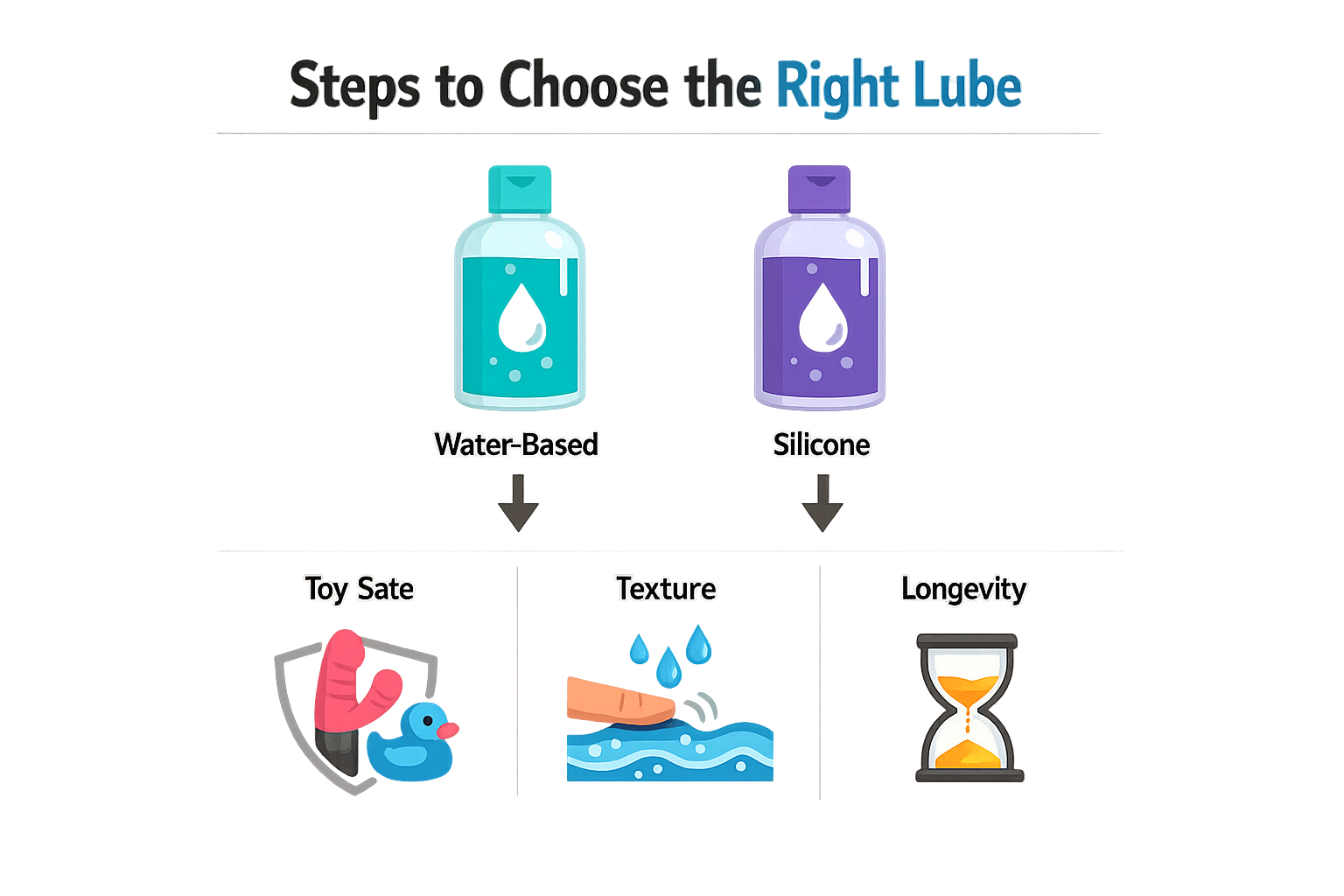
Choosing between Water-Based vs Silicone Lube isn't complicated once you know what your toys are made of. Most people overthink this — the actual decision tree is short.
Step 1: Check Your Toy's Material
Step 1
Identify the toy material
Look at the packaging or product listing. If it says "silicone," "body-safe silicone," or "medical-grade silicone," you're dealing with silicone. If it says TPE, jelly, rubber, glass, metal, or ABS plastic, it's not silicone.
Silicone toys are the majority of what's sold now — they're body-safe, easy to clean, and last longer than cheaper materials. If you bought a toy in the last five years from a decent retailer, it's probably silicone.
Step 2: Match Lube to Material
Step 2
Apply the compatibility rule
If your toy is silicone, use water-based lube. If your toy is not silicone (glass, metal, TPE, hard plastic), you can use either water-based or silicone lube.
Water-based lubes work with everything. They're compatible with silicone toys, condoms, and every other material. That's why most beginner guides default to water-based — it's the safe answer that never causes problems.
Step 3: Consider Your Play Style
Once you know what's safe, the next question is what works better for how you're using it.
Water-based lube:
- Dries out faster, especially during longer sessions
- Easy to clean — washes off with water, no residue
- Reactivates with water or spit if it gets tacky
- Cheaper per bottle
- Works with clit stimulators and every other toy type
Silicone lube:
- Stays slick much longer — ideal for marathon sessions or anal play
- Harder to wash off (needs soap, takes a few rinses)
- Doesn't dry out or get sticky
- More expensive
- Only safe with non-silicone toys (glass, metal, hard plastic)
If you own mostly silicone toys, water-based is the one that won't wreck your collection.
Step 4: Start With a Small Bottle
Don't buy the economy size of anything until you know you like the texture. Lube is weirdly personal — some people hate thick formulas, others can't stand runny ones. A 4 oz bottle is enough to figure out if it works for you.
If you're not sure what your toys are made of, default to water-based. It's the pick that doesn't punish you for guessing wrong.
Tips and Tricks for Using Lube with Toys
The actual use part is where most people mess up — not because it's complicated, but because nobody tells you the boring maintenance stuff that keeps your toys working longer than a month.
Apply Before You Start, Not After
Put lube on the toy and on yourself before things get going. Most people under-apply, then add more mid-session, which works but breaks the rhythm. Start with more than you think you need — water-based especially dries faster than you expect, and silicone lube spreads thin, so what looks like enough on your hand isn't always enough in practice.
Clean Your Toys Every Single Time
This isn't optional. Lube residue attracts dust, traps bacteria, and turns your storage drawer into a petri dish. Wash your toy with warm water and mild soap (or actual toy cleaner) before and after every use. It takes thirty seconds. Silicone toys are waterproof and handle soap well; if your toy has a motor, keep the charging port dry or rinse carefully.
You can still get infections and STDs from unclean toys — washing isn't about aesthetics, it's about not giving yourself a problem you didn't have before.
Store Lube and Toys Separately
Don't leave lube bottles sitting against your toys in a drawer. Silicone lube can transfer onto silicone toys over time even without direct application, and some water-based formulas leak or get sticky if the cap isn't tight. Keep lube upright in a cool spot, away from direct heat. If a bottle's been open for over a year, replace it — the preservatives break down and it starts to smell or separate.
For toys, store them in individual bags or cases if you've got more than two. This keeps dust off and prevents toys from touching each other, which matters if you've got a mix of materials.
Reapply Water-Based, Don't Overdo Silicone
Water-based lube dries out or absorbs during longer sessions. Keep the bottle nearby and reapply when things start to feel tacky — you're not doing it wrong, that's just how the formula works. A small spray bottle of water can reactivate dried water-based lube if you don't want to add more product.
Silicone lube lasts longer, so if you're adding more every few minutes, you're using too much or the toy's material is absorbing it (which means it's probably not body-safe silicone). One or two reapplications max for a typical session.
What to Skip
Don't use hand creams, lotions, or cooking oils as lube substitutes. They're not formulated for internal use, they break down condoms and some toy materials, and they're a nightmare to clean off. If you're traveling and forgot lube, buy a small bottle of actual lube — it's cheaper than replacing a toy you wrecked with coconut oil.
Avoid storing toys in direct sunlight or next to heating vents. Heat degrades both lube and toy materials faster, and you won't notice until the texture goes weird or the motor stops holding a charge.
For more on toy materials and what's actually body-safe, check out Clit Suckers Explained: How Pleasure-Air Toys Work — it covers material basics that apply across categories.
Conclusion
The Water-Based vs Silicone Lube question isn't really a question — it's a decision tree. Water-based works with everything, cleans up fast, and won't wreck your toys. Silicone lasts longer, feels slicker, and handles water play without washing away. Most people end up keeping both.
If you're just starting out, grab a water-based bottle first. It's the safe default. Once you know what you like — and what toys you're using — silicone makes sense for longer sessions or anything involving water. The real trick is matching the lube to the situation, not picking one and forcing it to work everywhere.
Patch-test silicone lube on any silicone toy before you commit to a full session. A small spot on the base tells you everything you need to know. If it gets tacky or weird, you've saved yourself a ruined toy. If it's fine, you're good to go.
Lube isn't complicated. The industry wants you to think it is — ten formulas, five viscosities, three pH levels — but the actual decision is straightforward. Water-based for daily use and all toys. Silicone for longer sessions and glass or metal. Don't overthink it. For more hands-free options that pair well with the right lube, check out our guide to butterfly vibrators.
Start with one bottle, see how it feels, and adjust from there. Most people figure out their preference within a week. The rest is just buying backups.
Frequently asked questions
Can you use silicone lube with silicone toys?
No. Silicone lube degrades silicone toys — the two materials bond and break down the toy's surface, making it permanently tacky or damaged. Always use water-based lube with silicone toys.
Which lasts longer, Water-Based vs Silicone Lube?
Silicone lube lasts significantly longer than water-based. Water-based formulas dry out or absorb during use and need reapplication, while silicone stays slick for extended sessions without breaking down.
Does water-based lube work with all toy materials?
Yes. Water-based lube is compatible with silicone, glass, metal, TPE, and every other toy material. It's the universal safe choice and works with condoms too.
How do you clean up after using silicone lube?
Silicone lube requires soap and warm water — it doesn't rinse off with water alone. Expect a few rinses to fully remove it from skin and toys. Water-based lube washes off instantly with just water.