
Sexual Identity: Understanding Orientation and Self-Discovery
Explore sexual identity, including orientation, preferences, and self-discovery. Learn how to understand and embrace your authentic self with confidence.
 Zoe Clarke

Understanding Your Sexual Identity
Sexual identity is one of those topics that gets treated like it should be obvious — like you wake up one day, check a box, and move on. Most people don't talk about the fact that figuring out your sexual identity is a process, not a revelation. It's not just about who you're attracted to. It's about how you understand your body, what you want, how you communicate that, and how all of it fits into your life.
The thing is, sexual identity isn't static. Research shows that sexual health — which includes identity, desire, arousal, and satisfaction — is influenced by cultural settings, personal development, and dynamic behavioral adaptation. What feels true at 20 might shift by 30 or 40, and that doesn't mean you got it wrong the first time. It means you're learning.
Here's what most guides miss: sexual identity is tied to sexual health in ways that go beyond orientation. Learning about your body, growing comfortable with your desires, developing the ability to communicate your needs — these are fundamental skills that take time to build. Some people figure it out quickly. For others, it takes years or decades. Both are normal. If you're trying to understand what actually matters when choosing a dildo or any other tool for exploration, you're already doing the work.
This guide walks through what sexual identity actually means, why it matters, how to explore it without overthinking it, and what mistakes to avoid along the way. No fluff, no assumptions that you should already know this stuff, and no pretending there's one right answer.
Explore the complexities of sexual identity, including orientation, preferences, and self-discovery in this comprehensive guide.
What is Sexual Identity?
Sexual identity is how you understand and label your own sexual self — who you're attracted to, what turns you on, and how you relate to sex and desire. It's not one thing. It's a cluster of related pieces: orientation (the genders you're drawn to), desire (what sparks sexual interest), and how you experience your body during sex.
Most people treat sexual identity like it's fixed at birth or locked in by your twenties. That's not how it works. Sexual identity can shift, clarify, or stay stable across your life. What matters is that it's yours — not what a label says it should be, not what your first relationship taught you, and definitely not what TikTok says is trending this month.
The Core Components
Sexual identity breaks into a few overlapping parts. Orientation is the big one — heterosexual, bisexual, pansexual, asexual, gay, lesbian, queer. It describes the pattern of who you're attracted to. Sexual desire is the presence of sexual thoughts, fantasies, and motivations to engage in sexual behavior in response to internal and external cues — basically, what gets your brain and body interested in sex. Embodied sexuality is your capacity to explore and express your sexuality with the knowledge, skills, and confidence to achieve positive outcomes like sexual well-being and agency. That last one is a fancy way of saying: can you actually do what you want sexually, or are you stuck performing what you think you're supposed to want?
These pieces don't always line up neatly. You can be attracted to multiple genders but only date one. You can have a high libido and zero interest in partnered sex. You can identify as straight and still find same-gender fantasies compelling. The point isn't to force everything into one clean box — it's to recognize what's true for you and let that guide how you show up sexually.
What Sexual Identity Is Not
Sexual identity isn't your gender identity (that's a separate thing about how you experience your own gender). It's not your relationship status, your kink preferences, or how often you have sex. And it's definitely not a performance for someone else's comfort. If you're spending more time worrying about what your sexual identity looks like to others than what it feels like to you, that's a sign you're optimizing for the wrong audience.
The friend who swears by labels usually has one that fits cleanly. The friend who resists them often doesn't — and both are fine. Sexual identity is a tool for self-understanding, not a checklist you have to complete to qualify as a real person. If a label helps, use it. If it doesn't, choosing what works for your body matters more than choosing what works for a form.
Why Understanding Sexual Identity Matters
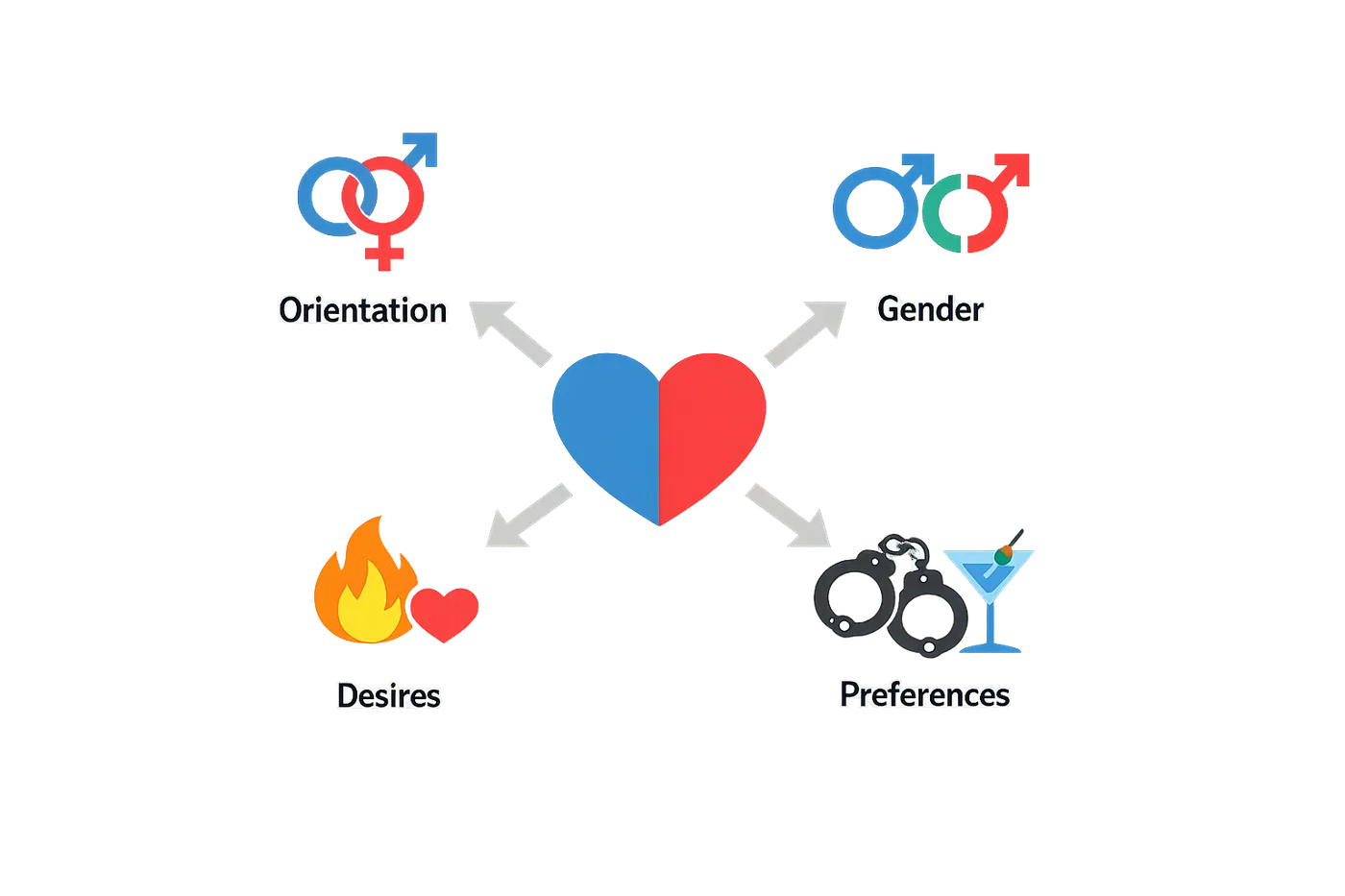
Most people treat sexual identity like it's either obvious or embarrassing to talk about — neither is true. Understanding your sexual identity isn't some wellness-journey fluff piece. It's the difference between spending years second-guessing what you want and actually showing up as yourself in relationships, friendships, and the private moments that matter.
Sexual health isn't just about orgasms or whether the plumbing works. It's a holistic experience that includes physical, emotional, mental, and social well-being. That means your sense of who you're attracted to, what you want, and how you communicate those things directly affects your mental health, your relationship satisfaction, and your overall quality of life. When you don't understand your own sexual identity, you're operating with incomplete information — and that shows up everywhere.
Mental Health and Self-Acceptance
People who spend years confused about or suppressing their sexual identity report higher rates of anxiety, depression, and general dissatisfaction. That's not because there's anything wrong with being queer, bi, ace, or anything else — it's because living inauthentically is exhausting. The mental load of monitoring what you say, who you're seen with, or how you present yourself adds up.
When you understand your sexual identity, you stop wasting energy on pretending. You can make decisions — about partners, about relationships, about how you spend your time — based on what you actually want, not what you think you're supposed to want. That clarity alone reduces a massive source of chronic stress.
Relationship Quality and Communication
If you don't know what you want, you can't communicate it. And if you can't communicate it, your partner is guessing. That's how you end up in relationships that feel off but you can't articulate why.
Understanding your sexual identity gives you the language to talk about attraction, boundaries, and what you're looking for in a partner. It also helps you recognize when a relationship isn't working — not because anyone did anything wrong, but because the fundamental shape of what you need doesn't match what's on offer. That's valuable information, and it saves everyone time.
For people in non-monogamous or queer relationships, this matters even more. Those relationship structures often require more explicit communication about desires, boundaries, and expectations. You can't negotiate those things if you're still figuring out what your own baseline is.
Personal Development and Autonomy
Sexual identity isn't static. It can shift over time as you learn more about yourself, as cultural language evolves, or as you have new experiences. Understanding that your identity is part of a developmental process — not a fixed trait you're supposed to have figured out by age 18 — takes the pressure off.
The process of exploring your sexual identity teaches you how to listen to yourself, how to sit with uncertainty, and how to make decisions based on your own internal compass rather than external expectations. Those are skills that transfer to every other area of your life. Learning to embrace your sexual desires and communicate your needs isn't just about sex — it's about developing the ability to advocate for yourself in any context.
Sexual health can be conceptualized as a fundamental skill set to be obtained as individuals become sexually active — including learning about your body, embracing your desires, and developing the ability to communicate your needs.
If you're still figuring out what you like physically, choosing a dildo based on your actual preferences (not what you think you're supposed to prefer) is a small but concrete example of this kind of self-knowledge in action.
The Bottom Line
Understanding your sexual identity matters because it affects your mental health, your relationships, and your ability to make decisions that actually align with who you are. It's not about labeling yourself for the sake of it — it's about having enough clarity to stop second-guessing and start living.
How to Explore Your Sexual Identity
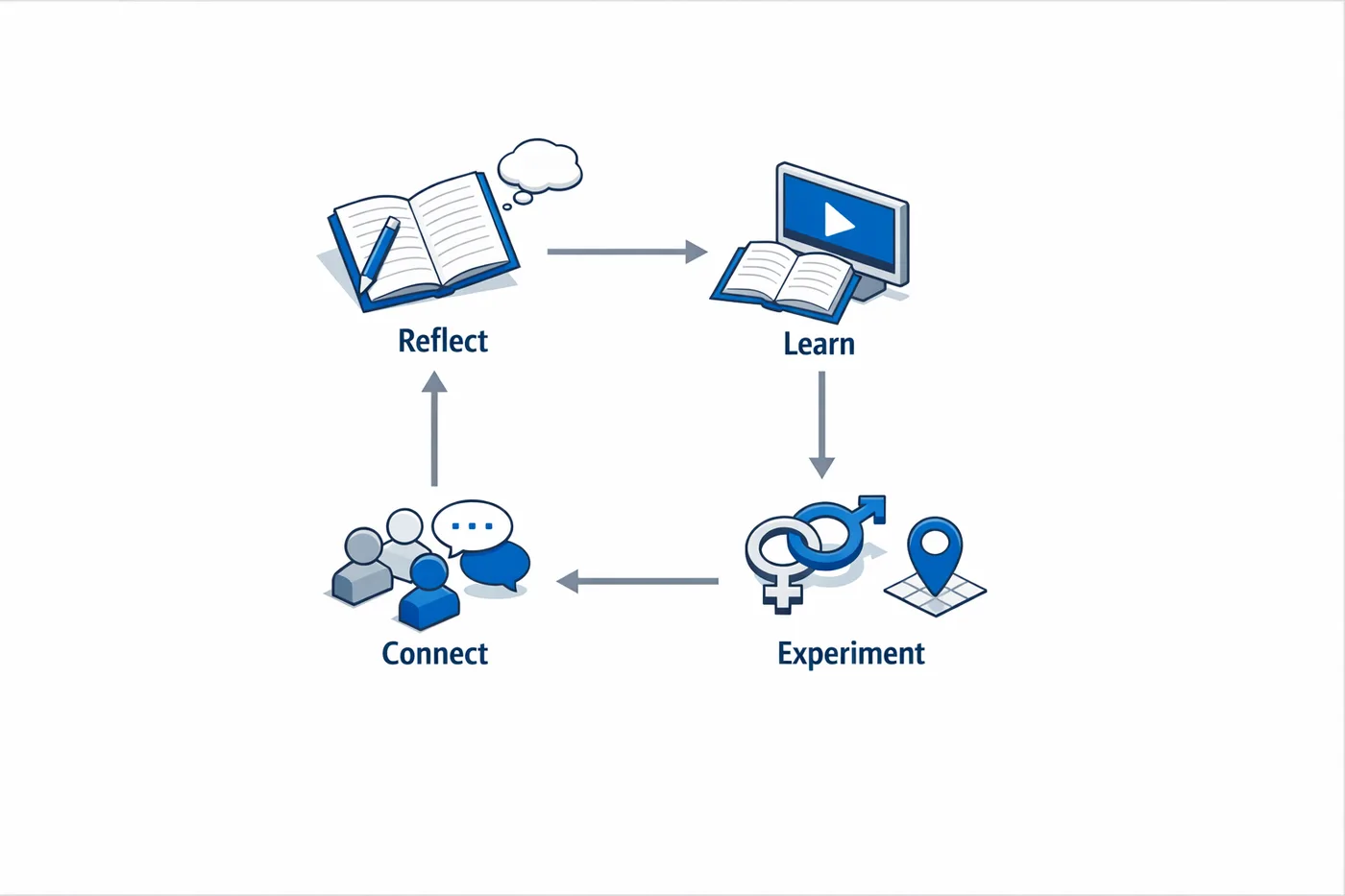
Sexual identity isn't something you figure out in one sitting. It's more like trying different things until you land on what feels right — and sometimes what feels right shifts over time. Most people treat this like it needs a roadmap, but the actual process is messier, more personal, and way less linear than that.
Here's the thing: exploration doesn't mean you need to label yourself immediately or commit to anything permanent. It means giving yourself permission to notice what you're drawn to, what you're curious about, and what doesn't resonate. That's it.
Start With What You Already Know
You probably already have clues. Think about who you're attracted to, what kind of content you seek out, what fantasies show up when you're not policing them. Write it down if that helps — not for anyone else, just for you. The goal is to acknowledge what's already there instead of starting from scratch.
Some people know early. Others don't figure it out until their thirties or later. Both are normal. If you're someone who's questioning, that's not a phase — it's part of the process.
Try Things in Low-Stakes Environments
Exploration works best when the pressure is off. That might mean:
- Engaging with online communities where people discuss their experiences (Reddit's r/bisexual, r/questioning, and similar spaces are solid starting points)
- Watching or reading content that reflects different identities and orientations
- Talking to people who've been through similar questions — not for answers, but for perspective
- Experimenting with how you present yourself in safe spaces (clothing, pronouns, language)
Physical exploration is part of this for some people. Toys designed for solo use — like versatile vibrators that let you explore different sensations — can help you figure out what your body responds to without needing to involve another person before you're ready.
Pay Attention to How Different Labels Feel
Labels are tools, not requirements. Some people find them clarifying; others find them limiting. Try a few on in your head. Does "gay" feel right? "Bi"? "Queer"? "Pansexual"? "Asexual"? "Straight but complicated"?
If none of them fit perfectly, that's fine. You're allowed to use the language that works for you, change it later, or skip labels altogether. The point is to find words that help you understand yourself, not to fit into someone else's taxonomy.
Give Yourself Time and Space to Change Your Mind
What you think is true about your identity today might shift in six months or six years. That's not failure — it's refinement. Sexual identity isn't static for everyone, and discovering something new about yourself doesn't invalidate what you thought before.
People get weird about this because they want certainty, but certainty isn't always available. What you can have is honesty about where you are right now.
Exploration doesn't mean you need to label yourself immediately or commit to anything permanent.
When to Seek Support
If the process feels overwhelming, talking to a therapist who specializes in LGBTQ+ issues can help. Not because something's wrong with you, but because having a neutral third party can clarify things that feel tangled when you're inside your own head.
Support groups — online or in-person — also work for some people. Hearing how others navigated similar questions can make the whole thing feel less isolating.
Best Practices for Navigating Sexual Identity
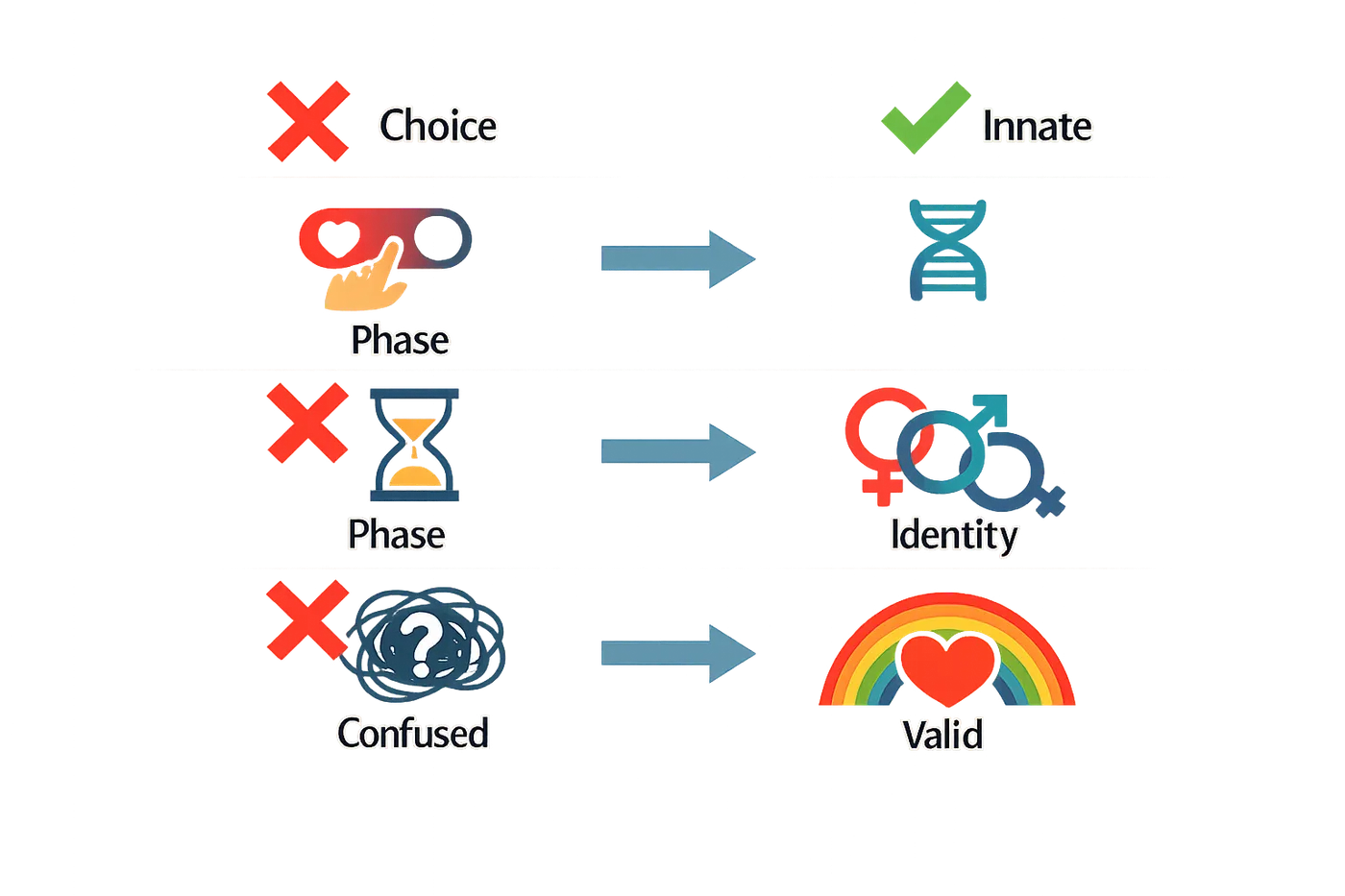
Navigating sexual identity isn't a one-and-done conversation — it's ongoing, messy, and shifts as you do. The friend who came out at 19 might reframe things at 29. The person who thought they had it figured out might realize they were working with incomplete information. Here's what actually helps when you're talking about this stuff with yourself or with others.
Start With What You Know, Not What You Should Know
Most people approach sexual identity like they're filling out a form — pick a label, check the box, move on. That's not how it works. You don't need a clean answer before you start exploring. You just need permission to notice what feels right and what doesn't.
If clitoral stimulation is what gets you there during solo sessions, that's data. If penetration alone doesn't do much for you, that's also data. Younger people tend to prioritize what actually works over what's supposed to work, partly because they have better access to real information and partly because the conversation has shifted toward pleasure as something you're allowed to want.
Communicate Without Performing
The biggest gap most people hit isn't figuring out what they want — it's saying it out loud to a partner. Research on orgasm frequency shows that partnered experiences predict sexual satisfaction more than solo ones, which makes sense: the emotional and relational parts matter. But that only works if you can actually talk about what's happening.
Sexual communication doesn't mean narrating every sensation like a performance review. It means being able to say "more of that" or "this isn't working for me" without it turning into a referendum on the relationship. The couples who get this right treat feedback like navigation, not criticism.
Learning to give and receive sexual feedback comfortably is what bridges the gap between what works solo and what works with a partner.
Shift From Performance to Pleasure
The default script — the one you see in movies, the one most people assume is standard — centers penetration and ends with one person's orgasm. That script is common, but it's not universal and it's definitely not the most pleasurable option for a lot of people.
Clinicians who work with sexual satisfaction talk about moving away from performance-based, orgasm-oriented models toward models that prioritize connection and pleasure. That doesn't mean orgasms don't matter. It means they're not the only thing that matters, and chasing them at the expense of everything else usually backfires.
If you're someone who needs clitoral stimulation during penetration, that's not a workaround — it's just how your body works. Treating it like a bonus feature instead of a core requirement is where people get stuck.
Don't Outsource Your Preferences to a Partner
One pattern that shows up constantly: people who know exactly what works during solo sessions but go blank when a partner asks what they want. The assumption is that a good partner should just know, or that asking feels unromantic, or that your preferences should adapt to what's happening in the moment.
None of that is true. Bringing what works solo into partnered contexts isn't selfish — it's the entire point. If you know that a specific rhythm, pressure, or angle gets you there, that's information worth sharing. The partner who wants you to enjoy yourself will appreciate the roadmap.
Normalize the Full Range of Activities
Penetration-only sex is one option. It's not the default, and it's definitely not the most common path to orgasm for people with clitorises. Normalizing a wider range of activities — oral, manual, toys, whatever combination works — takes the pressure off any single act to be The Thing That Counts.
This also applies to solo activities. There's still stigma around masturbation in some communities, and that stigma keeps people from learning what works for their own bodies. If you don't know what gets you there solo, it's a lot harder to communicate it to someone else.
Account for Culture and Context
Sexual identity doesn't exist in a vacuum. Cultural background, religious beliefs, and community expectations all shape how people understand and talk about sexuality. Therapeutic approaches that ignore those contexts tend to fail.
For some people, frameworks that work in one cultural setting feel completely wrong in another. A therapist suggesting masturbation as a first-line treatment might be standard in one context and culturally inappropriate in another. The interventions that work best are the ones that involve the community in the process and adapt to the client's actual life, not an idealized version of it.
Common Mistakes in Understanding Sexual Identity
Most people get sexual identity wrong in the same predictable ways — treating it like a fixed checkbox instead of something that can shift, assuming everyone's experience matches their own, or confusing attraction with behavior. These mistakes aren't just abstract errors. They shape how you talk to partners, how you interpret your own feelings, and whether you feel like your experience is "normal" enough to count.
The biggest mistake is treating sexual identity as a single, stable fact about yourself that you discover once and file away. That's not how it works for most people. Sexual identity can evolve — what felt true at 20 might not fit at 30, and that doesn't mean you were lying to yourself the first time. Research on sexual health as a developmental process shows that learning about your body, embracing desire, and developing comfort with your sexual needs happens over years, sometimes decades. For many people, sexual identity follows the same timeline.
Assuming Identity and Behavior Always Match
Another common error: assuming that sexual identity and sexual behavior are the same thing. They're related, but they're not identical. Someone might identify as straight and occasionally experience same-sex attraction. Someone might identify as bisexual and only date one gender. Someone might be in a long-term relationship with a partner of one gender and still identify as attracted to multiple genders. None of those scenarios are contradictions — they're just examples of how identity (how you understand yourself) and behavior (what you actually do) don't always line up neatly.
This mismatch trips people up because we're used to treating labels as rules. If you call yourself X, you're supposed to act like X all the time. But sexual identity isn't a contract. It's a description of how you experience attraction, and attraction doesn't always translate directly into action.
Ignoring Cultural and Social Context
A third mistake: ignoring the role of culture, religion, and social context in shaping how people understand and express their sexual identity. Sexual dysfunction and sexual health issues are often experienced in the context of psychosocial factors, including cultural background, relationship conflicts, and shame or embarrassment about sexuality due to religious beliefs or familial inhibitions. This isn't just about dysfunction — it's about how people frame their entire sexual identity.
For example, someone raised in a religious community that views certain forms of attraction as sinful might take much longer to acknowledge or explore their sexual identity, not because the identity isn't real, but because the social cost of naming it is high. Treating sexual identity as purely an internal, individual process ignores the very real external pressures that shape how and when people come to understand themselves.
Treating Pleasure and Identity as Separate
A fourth mistake: separating sexual pleasure from sexual identity, as if one has nothing to do with the other. But the two are deeply connected. Pleasurable sexual experiences involve not only physiological factors like orgasms and lubrication but also emotional components such as desire, arousal, and satisfaction. If you don't understand your own sexual identity — what you're actually attracted to, what kind of intimacy you want, what feels right to you — it's much harder to communicate what you need or to recognize when something isn't working.
This is especially true for people who spend years trying to fit into a sexual identity that doesn't match their actual experience. If you're spending all your energy performing a version of sexuality that doesn't feel authentic, pleasure becomes much harder to access. Understanding your sexual identity isn't just about labels — it's about building a foundation for sexual experiences that actually feel good.
Overvaluing Labels
Finally: overvaluing labels themselves. Labels can be useful. They give you language, they help you find community, they make it easier to explain yourself to partners. But they're not the point. The point is understanding what you want, what feels true to you, and how to build a sexual life that aligns with that. If a label helps, great. If it doesn't, you don't need one.
The mistake is treating the label as the goal — spending years trying to figure out which box you fit into instead of just paying attention to what you actually feel and want. Sexual identity is a tool for self-understanding, not a test you have to pass.
For more on understanding your body and what works for you, see Choosing a Dildo: Materials, Sizes, and What Actually Matters.
Frequently Asked Questions about Sexual Identity
Is sexual identity the same as sexual orientation?
No, but they're related. Sexual orientation is one piece of your sexual identity — it describes who you're attracted to. Sexual identity is bigger: it's how you understand yourself sexually, which includes orientation but also how you relate to your body, what you want, and how you communicate those wants.
Think of orientation as a category (gay, straight, bi, etc.) and identity as the full picture of how you show up sexually.
Can my sexual identity change over time?
Yes. Sexual identity isn't locked in at 18. Some people figure it out early and stay consistent. Others shift — sometimes gradually, sometimes suddenly — as they learn more about themselves or as their circumstances change.
That doesn't mean your earlier identity was fake or wrong. It means you're allowed to grow.
How do I know if I'm just confused or if my identity is actually shifting?
Confusion and exploration look similar from the inside. The difference is usually time and pressure. If you're asking yourself honest questions and giving yourself room to sit with uncertainty, that's exploration. If you're panicking because you think you need an answer right now, that's confusion driven by external pressure.
Most people who are genuinely exploring their identity don't feel confused — they feel curious. The confusion comes when you think you owe someone (including yourself) a final answer faster than you're ready to give one.
Do I need to label my sexual identity?
No. Labels are tools, not requirements. Some people find them clarifying — a shorthand that helps them communicate who they are. Other people find them limiting or just unnecessary.
If a label feels useful, use it. If it doesn't, don't. You're allowed to describe yourself in whatever terms make sense to you, even if that's "I don't use labels."
What if my sexual identity doesn't match what my partner expects?
That's a compatibility issue, not an identity problem. Your sexual identity is about you — how you understand yourself and what you want. If a partner can't work with that, the issue is the relationship dynamic, not your self-understanding.
Good partners adapt. They ask questions, they stay curious, and they don't treat your identity as a threat to the relationship. If someone is pressuring you to fit a version of yourself that isn't accurate, that's worth examining.
How do I talk to a partner about my sexual identity if I'm still figuring it out?
Start with what you do know, even if it's incomplete. "I'm exploring what I'm into" or "I'm still figuring out how I identify, but here's what feels true right now" is a perfectly legitimate opener.
You don't need a polished final answer to have the conversation. Most partners appreciate honesty over certainty — it's the withholding or pretending that creates problems, not the uncertainty itself.
You don't owe anyone a final answer faster than you're ready to give one.
Is it normal to feel like my sexual identity is different depending on the context?
Yes. Sexual identity isn't always static across contexts. Some people identify differently in different relationships, or feel one way in theory and another in practice. That's not dishonesty — it's nuance.
The question isn't whether your identity is perfectly consistent. The question is whether you're being honest with yourself and the people you're with about what feels true in that moment.
What if I don't feel like I fit into any of the common categories?
Then you don't. Sexual identity categories are descriptive, not prescriptive — they exist to help people communicate, not to box everyone into pre-set options. If none of the common labels fit, you can use a less common one, create your own, or skip labels entirely.
The goal is self-understanding, not fitting into a category that someone else invented.
How do I handle people who don't take my sexual identity seriously?
Set boundaries and decide how much energy you're willing to spend. Some people are worth educating — they're curious, they mean well, they just don't get it yet. Other people are committed to not getting it, and no amount of explanation will change that.
You don't owe everyone a defense of your identity. Sometimes the best response is "This is how I identify" and nothing more.
Can exploring my sexual identity affect my mental health?
It can, in both directions. For a lot of people, figuring out their sexual identity reduces anxiety and increases self-acceptance — it's clarifying. For others, especially in unsupportive environments, the process can be stressful or isolating.
If exploring your identity is bringing up difficult emotions, that's not a sign you're doing it wrong. It's a sign the process matters, and it might be worth talking to someone (a therapist, a trusted friend, a community) who can support you through it.
Conclusion: Embracing Your Sexual Identity
Sexual identity isn't a box you check once and forget about. It's something you understand better over time — sometimes quickly, sometimes slowly, and sometimes in ways that surprise you. The people who get this right are the ones who stop treating it like a problem to solve and start treating it like information worth knowing.
Most of the confusion around sexual identity comes from thinking it has to be fixed or final. It doesn't. What matters is that you're honest with yourself about what feels right now, and that you give yourself permission to adjust that understanding as you learn more. The version of you at 22 might not need the same labels as the version at 35, and that's fine.
Sexual health is a holistic experience of well-being that includes physical, emotional, mental, and social aspects — not just the absence of dysfunction.
If you're still figuring things out, the best move is to focus on what actually feels good rather than what you think should feel good. That applies to attraction, to relationships, to the toys you choose, and to how you talk about all of it. Choosing a Dildo is easier when you know what you're actually looking for — the same logic applies here.
The friend who has this dialed in is the one who stopped waiting for certainty and started paying attention to patterns. You don't need a perfect answer. You need enough clarity to make decisions that work for you, and enough flexibility to change your mind when new information shows up. That's it.
Related reading
Sexual Wellness for Women Over 60: Products That Actually Work
Quiet Couples Toys for Discreet Intimacy
Personalized Plush Toys: Customizable Couples Toys for a Personalized