
Gender Identity vs Sexual Orientation: Key Differences
Explore the key differences between gender identity vs sexual orientation, and learn what you need to know about each concept.
 Zoe Clarke

Introduction
Gender identity vs sexual orientation: these terms get lumped together constantly — in conversation, in policy debates, even in well-meaning educational materials. The problem is they're not the same thing, and treating them like interchangeable terms creates confusion where there doesn't need to be any.
Gender identity vs sexual orientation answers two completely different questions. Gender identity is about you — how you understand your own gender, independent of what anyone else thinks or expects. Sexual orientation is about attraction — who you're drawn to, if anyone. One is internal. The other is relational. They can overlap in some experiences, but they answer completely different questions.
This matters more than it sounds like it should. When people collapse these concepts into one vague category, it becomes harder to talk about either one clearly. It also makes it easier to dismiss both as trends, phases, or things that don't require actual understanding. The reality is that both gender identity and sexual orientation shape how people move through the world, and getting the distinction right is the baseline for any conversation that doesn't waste everyone's time.
The confusion isn't always malicious — sometimes it's just that both concepts challenge older frameworks that treated gender and attraction as fixed, binary, and determined by biology alone. But intent doesn't fix the problem. If you want to understand how adult toys for couples work across different relationship structures, or why certain products resonate differently depending on identity and orientation, you need to start with the basics: what these terms actually mean, and why they're not synonyms.
Understanding the Confusion
The mix-up between gender identity and sexual orientation happens constantly — in group chats, on TikTok, in well-meaning conversations where someone's trying to be supportive but ends up conflating two completely different things. It's not malicious. It's just that both concepts deal with identity, both live under the LGBTQ+ umbrella, and both challenge the default assumptions most people grow up with. So they get lumped together, even though they answer entirely different questions about who you are.
Part of the confusion comes from how culture talks about bodies and desire. Heteropatriarchy constructs women's bodies as deviant and other, in need of "improvement" and correction, based on abstract ideologies and distinctive cultural norms. That framing doesn't just police how bodies should look — it also polices who those bodies should want and how they should identify. When the "normal" script is so rigid (cisgender + heterosexual = default), anything outside that script feels like it must all be part of the same "other" category. It's not.
Another layer: the coital imperative — the assumption that heterosexual penetrative sex is the only "real" sex — reinforces the idea that gender and attraction are inherently linked. If "normal" sex requires a man and a woman in specific roles, then challenging your gender or your orientation feels like challenging the same system. But they're separate challenges. A trans woman who's attracted to women is navigating her gender identity (woman) and her sexual orientation (lesbian) as two distinct parts of her experience. Conflating them erases that nuance.
The result is a lot of awkward moments where someone asks a gay man if he "feels like a woman," or assumes a non-binary person must be pansexual, or treats a straight trans guy like he's "basically a lesbian." None of that tracks. The confusion isn't helping anyone — it just makes conversations harder and leaves people feeling like they have to explain themselves twice. If you want to understand the actual difference, you have to stop treating gender and orientation like they're two flavors of the same thing. They're not. One is about your internal sense of self. The other is about who gets your attention. Totally different questions.
What's the Difference Between Gender Identity vs Sexual Orientation?
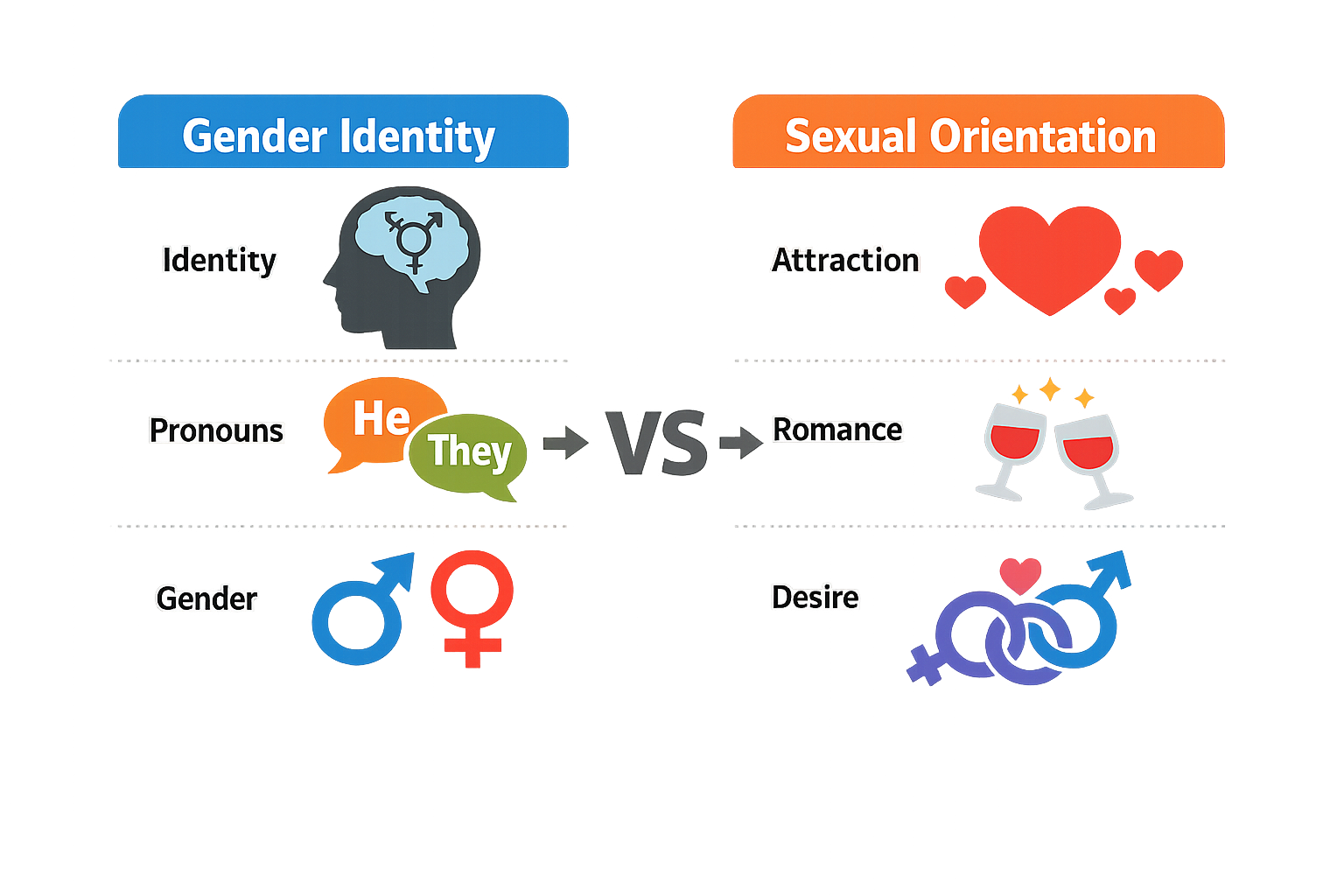
Here's the thing: gender identity vs sexual orientation represents two completely separate concepts, and mixing them up is like confusing what you wear with who you're attracted to. They operate on different axes entirely.
What Gender Identity Actually Means
Gender identity is about who you are — specifically, your internal sense of your own gender. It's the answer to "What gender do I experience myself as?" not "What did the doctor write on my birth certificate?"
Some people identify as the gender they were assigned at birth (cisgender). Others don't — they might be transgender, non-binary, genderfluid, or any number of identities that fall outside the binary. Your gender identity lives inside you. It's not about who you're sleeping with or what your body looks like.
What Sexual Orientation Actually Means
Sexual orientation, on the other hand, is about who you're attracted to. It answers "Who do I want to date, sleep with, or build a life with?" — and it has nothing to do with your own gender.
You can be a cisgender woman attracted to women (lesbian), a transgender man attracted to men (gay), a non-binary person attracted to multiple genders (bisexual or pansexual), or any combination that fits your actual experience. The two concepts don't dictate each other.
Research on sexual behavior shows this independence clearly — in studies of men who have sex with men (MSM), participants identified across a spectrum: 43.13% as gay, 45.67% as bisexual, and smaller percentages as transgender or other orientations. Notice that sexual orientation (gay, bisexual) and gender identity (transgender) appear as distinct categories in the same population, because they measure different things.
The Chart Everyone Wishes They'd Seen Earlier
Why the Confusion Happens
The mix-up makes sense if you've only ever seen these concepts bundled together under "LGBTQ+" — a shorthand that groups gender and sexuality because they share a history of marginalization, not because they're the same thing. But lumping them together in conversation leads to the assumption that a trans woman must be attracted to men, or that a lesbian must present in a certain way. Neither is true.
For a clearer breakdown of how different identities work in practice, exploring vibrating rings for couples or how to use a clit sucker can show how partners navigate attraction and compatibility across different orientations and identities.
Your gender identity is about you. Your sexual orientation is about who you're drawn to. They're independent variables.
Once you see them as separate, a lot of the noise clears up — and the actual conversations about identity, attraction, and how people experience both become a lot less confusing.
Tips for Navigating Conversations Around Gender and Sexuality
Talking about gender identity and sexual orientation doesn't have to be weird. Most people fumble these conversations not because they're malicious, but because they're overthinking it. The goal isn't to be perfect — it's to be respectful and willing to learn.
Start with What People Tell You
The simplest rule: believe people when they tell you who they are. If someone says they're nonbinary and gay, you don't need to understand the full mechanics of how that works — you just need to accept it. Gender identity is about how someone experiences themselves. Sexual orientation is about who they're attracted to. Those are two separate things, and the person living them knows more about their own experience than you do.
When someone shares their identity, the appropriate response is usually just "thanks for telling me" or "got it." You don't need to ask follow-up questions about their body, their history, or how they knew. If they want to share more, they will.
Use the Right Words (and Fix It When You Don't)
Pronouns matter. Names matter. If you mess up, correct yourself quickly and move on. Don't make a big apologetic production out of it — that centers your discomfort instead of the person you misgendered. Just say "sorry, she" and keep talking.
If you're not sure what someone's pronouns are, it's fine to ask: "What pronouns do you use?" It's a normal question now. Introducing yourself with your own pronouns ("I'm Zoe, she/her") signals that you're someone who gets it.
Don't Treat It Like a Teaching Moment for You
People are not walking encyclopedias of LGBTQ+ 101. If you're curious about the broader concepts — what pansexual means, how nonbinary identity works, why some people use they/them — Google it. Don't ask the one queer person in the room to explain their entire identity to you unless they've explicitly offered.
There's a difference between someone volunteering information and you demanding an education. If a friend says "I'm bisexual," the response is not "so does that mean you're attracted to everyone?" It's "cool, thanks for sharing."
Avoid the Invasive Questions
Some questions are nobody's business. Don't ask about someone's body, their surgical status, or their sex life unless you're in a context where that's explicitly appropriate (like a doctor's office or a very close friendship where they've invited that conversation). "Have you had the surgery?" is not small talk. Neither is "but how does sex work for you?"
If you're genuinely trying to understand how to be supportive, frame it that way: "Is there anything I should know to make sure I'm being respectful?" That's different from "explain your genitals to me."
Recognize That People Can Be Multiple Things
Someone can be a transgender man and also be gay. Someone can be nonbinary and also be bisexual. Gender identity and sexual orientation are independent axes — they don't cancel each other out or contradict each other. If it seems confusing, that's because you're trying to fit someone into a binary framework that doesn't apply to them.
The framework that matters is the one they're using. Your job is to listen, not to reclassify them into something that makes more sense to you.
The goal isn't to understand every detail of someone's identity — it's to respect it enough to use the right words and not make it weird.
When You Screw Up, Own It and Move Forward
You will mess up. Everyone does. The difference between someone who's trying and someone who's not is what happens next. If you use the wrong name, misgender someone, or say something ignorant, apologize briefly and do better. Don't spiral into self-flagellation or demand reassurance that you're still a good person.
"Sorry, I'll get it right" is the whole script. Then actually work on getting it right.
Know That It's Not About You
When someone tells you their gender identity or sexual orientation, they're not asking for your opinion on it. They're telling you a fact about themselves. Your comfort level with that fact is not their problem to manage. If you're struggling with it, that's something to work through on your own time — not something to unload on them.
Respect doesn't require full comprehension. It just requires you to take people at their word and treat them accordingly. For more on navigating identity and attraction, check out adult toys for couples — it's a similar principle of starting with what people actually want, not what you assume they should want.
Conclusion
Here's the thing nobody tells you: understanding the difference between gender identity vs sexual orientation isn't just about getting the terminology right — it's about recognizing that people are more than one-dimensional labels. Gender identity is who you are when you wake up in the morning. Sexual orientation is who you're drawn to. They're separate systems, and conflating them is where most confusion (and most harm) starts.
The research shows that these concepts play out differently across communities — what matters in a heterosexual monogamous relationship might look entirely different in queer or non-monogamous contexts. That variability isn't a bug; it's the point. People experience gender and attraction in ways that don't fit neatly into the boxes we inherited from outdated frameworks.
If you're still figuring out how to navigate conversations around these topics, exploring resources like best pegging dildos or vegan dildos can be surprisingly useful entry points — talking about pleasure and bodies often opens the door to deeper discussions about identity and desire. The goal isn't perfection; it's showing up with curiosity instead of assumptions.
Respect starts with listening. When someone tells you who they are or who they're attracted to, believe them. The categories matter less than the person in front of you.