How to Choose the Best Finger Vibrators for Your Needs
Explore our guide on finger vibrators, learn how to choose the right one, and find key product features to consider for your needs.

Introduction to Finger Vibrators
Finger vibrators are compact vibrators designed to sit on, around, or between the fingers, allowing for targeted vibration combined with the control and precision of your hand. If you've ever wished a regular vibrator gave you more control over exactly where the stimulation lands, that's the problem these solve. You're not waving a wand around hoping for the best — you're using your own fingers, which already know what they're doing, with a little motorized assist.
The appeal is straightforward: you get the manual dexterity and responsiveness of your hand, plus consistent vibration you don't have to generate yourself. That combination makes them popular for clitoral stimulation, nipple play, and anywhere else precision matters more than coverage. They're also less intimidating than larger toys, which is why they show up in a lot of first-time-buyer carts — though that doesn't mean every finger vibe is beginner-friendly. Some are great, some are gimmicks, and some are just poorly designed for actual human hands.
If you're trying to figure out which finger vibrator makes sense for you, the decision usually comes down to a few practical factors: how it attaches (strap, ring, or grip), whether it's rechargeable or battery-powered, and whether the shape actually fits your hand comfortably. The good news is that once you understand those basics, the choice gets a lot simpler. For more guidance on choosing vibrators that suit specific needs, check out our guide on how to choose quiet vibrators without the guesswork.
What Makes Finger Vibrators Different
Unlike wand vibrators or bullet vibes that you hold separately, finger vibrators become an extension of your hand. You're not gripping a handle — the motor sits directly on your finger, so every movement you make translates immediately to where the vibration lands. That direct contact means you can adjust pressure, angle, and speed in real time without repositioning a separate device.
The trade-off is size. Because they're small enough to wear on a finger, the motors are usually less powerful than what you'd find in a dedicated wand or rechargeable bullet. That's fine for targeted stimulation, but if you need deep, rumbly vibration or broad coverage, a finger vibe probably isn't the right tool. They're precision instruments, not power tools.
Understanding the Challenges in Choosing Finger Vibrators
Here's the part nobody tells you: most people buy the wrong finger vibrator the first time. Not because they're dumb, but because the product photos all look the same and the descriptions are useless. You're staring at a grid of silicone loops and straps, wondering if "ergonomic fit" means it'll stay on your index finger or fly across the room mid-use. Spoiler: sometimes it's the latter.
Why Finger Vibrators Are Harder to Shop Than You'd Think
The core problem is that finger vibrators aren't standardized. A bullet vibe is a bullet vibe — you know what you're getting. But finger vibes come in wildly different attachment styles: elastic loops, rigid rings, claw-style grips, strap systems. Some fit like a ring pop. Others feel like you're wearing a tiny saddle. And because most retailers use the same four stock photos, you can't tell which is which until it arrives.
Then there's the fit issue. Fingers aren't universal. If you've got larger knuckles or longer fingers, that one-size-fits-all elastic band might cut off circulation or slide around. If your hands are smaller, the motor might wobble or the whole thing might rotate during use. And nobody mentions this in the product copy because "fits most users" sounds better than "we didn't test this on actual hands."
The Stability-Versus-Comfort Trade-Off
Even when the fit is decent, you're stuck with a trade-off: tight enough to stay put, or loose enough to stay comfortable. A snug attachment keeps the vibe stable during movement, which matters if you're using it on yourself or a partner. But too tight and your finger goes numb after three minutes. Too loose and the motor shifts off-target every time you adjust pressure. It's a Goldilocks problem, and most products don't give you adjustment options.
The cheapest finger vibe that actually stays on your finger is worth more than the fanciest one that doesn't.
Vibration strength is another blind spot. Some finger vibes are strong enough to feel through your hand; others are so weak you're basically just poking someone with a buzzing plastic nub. And because "powerful motor" is marketing speak, not a spec, you won't know until you turn it on. If you're used to a standard bullet or wand, a lot of finger vibes will feel like a downgrade.
Cleaning and Practicality Get Overlooked
Nobody thinks about cleaning until they're holding a wet, lube-covered finger vibe with seventeen crevices and a fabric strap. Rigid ring-style designs are easier to rinse. Strap-and-buckle systems are a pain. And if the motor isn't fully waterproof, you're stuck doing a careful wipe-down instead of just running it under the tap. For a product you're supposed to use during sex — when things get messy — ease of cleaning should be a top-line feature, but it's usually buried in the fine print.
The other practicality issue: rechargeable versus battery-powered. Rechargeable sounds better on paper, but if the charging port is awkwardly placed or the battery life is short, you'll end up annoyed. Replaceable batteries mean you're never stuck waiting for a charge, but also mean you're buying watch batteries every few weeks. Neither option is perfect, and most product pages don't tell you which type of battery it uses or how long a charge lasts.
For more advice on keeping any vibrator in working order, see How to Clean a Vibrator: Check the Material, Motor and Manual First.
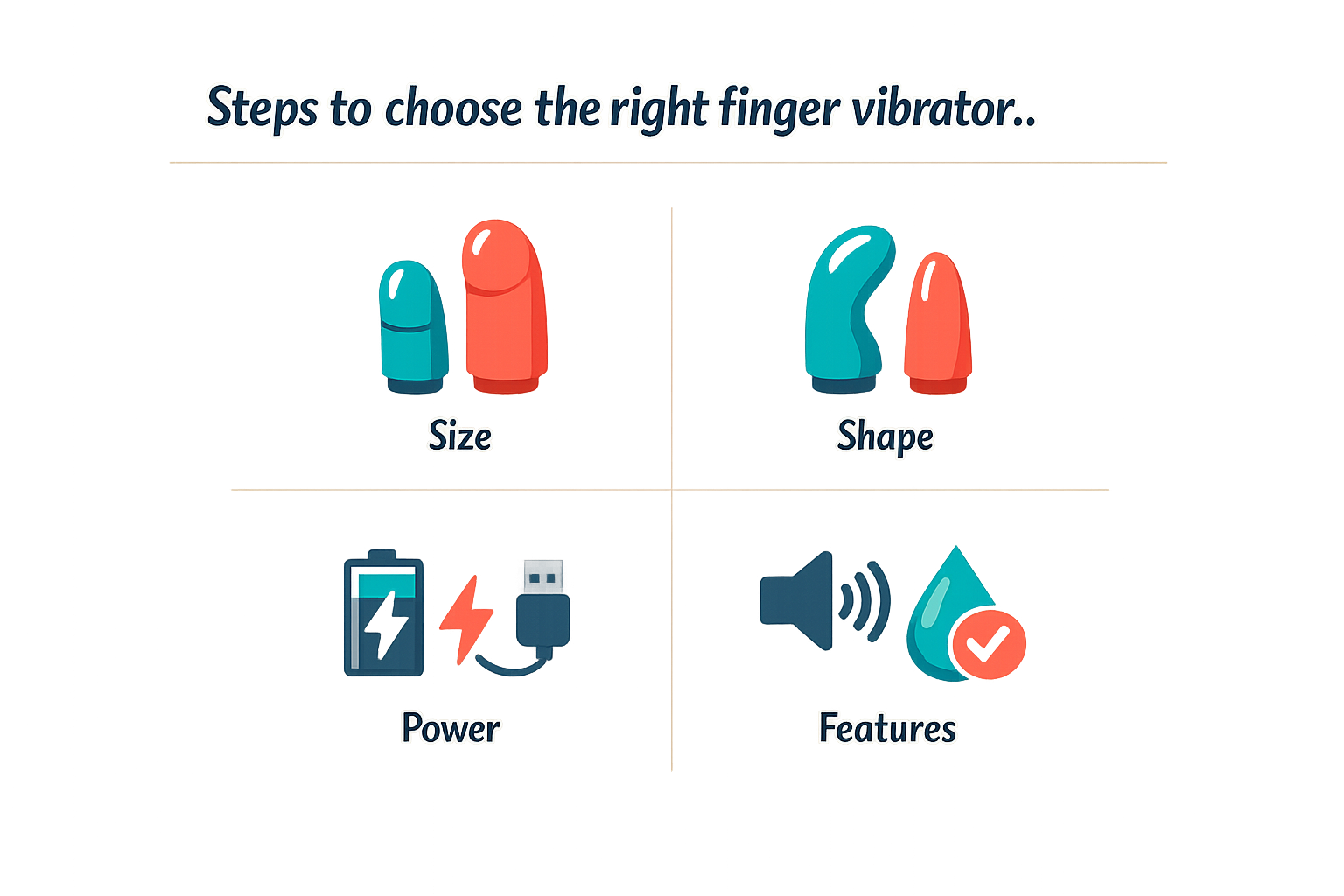
How to Choose the Right Finger Vibrator
Most people walk into this category expecting something complicated. It's not. Finger vibrators are the least fussy toy you'll buy — if you know what actually matters and what's just marketing noise. The decision tree is short: attachment style, fit, power, and whether you can clean it without wanting to throw it away. That's it.
Start With Attachment Style and Hand Fit
Step 1
Check how it stays on your finger
Finger vibrators use loops, sleeves, or strap systems. Loops are fastest to put on and take off but can feel tight on larger fingers. Sleeves (like silicone tubes you slide over your finger) fit a wider range of hand sizes but can slip during use if they're too loose. Straps with adjustable closures give you the most control but add a step when you're trying to get started.
Step 2
Test the grip for your hand size
If you have larger fingers, look for designs with wider loops or adjustable straps — models like the VeDO Yumi are explicitly built to fit both slim and larger fingers comfortably. If you have smaller hands, a sleeve-style design may slide around too much; a snug loop or strap will keep the motor exactly where you want it.
Comfort isn't about luxury — it's about whether the thing stays put when your hand moves. If the attachment pinches, digs in, or shifts mid-use, you'll spend more time adjusting than enjoying it.
Prioritize Vibration Strength and Control
Step 3
Decide how much power you need
Vibration strength is the single most important spec after fit. If you know you prefer deep, rumbly sensations, look for models that advertise multiple intensity levels or "powerful motor" in the description. If you're sensitive or new to vibration, a model with a wide range of settings (including very light modes) will give you room to experiment without overwhelming yourself.
Ease of operation matters more than you'd think. Can you change settings without taking the toy off your hand? Are the buttons easy to find by touch, or will you be fumbling mid-session? If a model requires two hands to operate, it defeats the point of a finger vibrator.
Consider Flexibility, Noise, and Cleaning
Step 4
Check flexibility for different angles
Some finger vibrators have rigid bodies; others flex or pivot. If you want to reach multiple erogenous zones without repositioning your whole hand, look for designs with a flexible joint or softer silicone body. Rigid models work fine for targeted clitoral stimulation but won't adapt to curves as easily.
Step 5
Evaluate noise level if discretion matters
Most finger vibrators are quieter than wand-style toys, but cheaper motors can still buzz loudly. If you share walls or want something discreet, check reviews for mentions of noise — or look for models that specifically advertise "whisper-quiet" operation. For more guidance on this, see our guide on how to choose quiet vibrators without the guesswork.
Step 6
Make sure you can actually clean it
Waterproof designs (fully submersible, not just splash-proof) are the easiest to clean — rinse under warm water with mild soap, dry, done. Non-waterproof models require more careful spot-cleaning and can trap moisture in seams. If the attachment has fabric components or intricate textures, plan for extra cleaning time. Silicone is the easiest material to sanitize; avoid porous materials unless you're using a barrier like a glove.
Match the Design to Your Use Case
Versatility and design quality show up in small details: does the motor sit flat against your fingertip, or does it jut out awkwardly? Can you wear it on any finger, or is it shaped for one specific digit? Does the charging port have a secure cover, or will it let water in after a month?
If you're buying your first finger vibrator, start with a mid-range model that checks all the basics: adjustable fit, at least 3 intensity levels, waterproof, and simple one-button control. You can always upgrade to something more specialized once you know what you actually use it for.
Tips and Tricks for Using Finger Vibrators
Once you've picked a finger vibrator, actually using it well is where most people stumble. The learning curve is short, but a few practical tweaks make the difference between "meh" and "oh, that's what the hype was about."
Start Low and Work Up
Most finger vibes have multiple settings, and the temptation is to crank it to max immediately. Don't. Start on the lowest setting and give your body 30–60 seconds to adjust before stepping up. High-intensity vibration can numb sensation if you jump in too fast, and then you're chasing a feeling that's already gone.
Use Lube (Yes, Even for External Use)
Finger vibrators are designed for direct contact, which means friction. A water-based lube makes everything glide better and prevents that scratchy, dragging feeling some textures can create. You don't need much — a pea-sized amount is plenty for most sessions.
Experiment With Angles and Pressure
The "right" way to use a finger vibe is whatever works for your anatomy. Try different angles: flat against the clitoris, angled from the side, or even light circular motions. Pressure matters too — some people need firm, sustained contact, while others prefer a lighter, teasing touch. Give yourself permission to move around and adjust in real time.
As someone who actually prefers using my fingers for direct clitoral stimulation, I know what a game-changer finger vibrators can be!
Clean It Immediately After Use
This isn't a tip, it's a rule. Silicone and body fluids are a bacteria party waiting to happen if you let a toy sit. Rinse with warm water and mild soap (or a toy cleaner) right after use, dry it completely, and store it in a clean, dry spot. Future you will thank present you. For detailed material-specific guidance, see How to Clean a Vibrator: Check the Material, Motor and Manual First.
Charge It Before It Dies Completely
Rechargeable finger vibes perform best when you top them off before they hit zero. Letting the battery fully drain repeatedly shortens its lifespan. If your vibe starts feeling weaker mid-session, that's your cue to plug it in afterward — don't wait until it's completely dead.
Don't Overthink the "Perfect" Technique
There's no single correct method. If a beginner-friendly option like the Lovehoney Ignite gives you a range of settings to explore, use that variety to figure out what you like — not to stress about finding some mythical ideal pattern. The best technique is the one that feels good to you, full stop.
Conclusion: Finding the Perfect Finger Vibrator
Choosing the right finger vibrator comes down to three things: knowing what you actually need, ignoring the hype, and not overthinking it. If you want hands-free clitoral stimulation during partnered play, pick a wearable with adjustable straps. If you want precise control and easy cleanup, go for a silicone sleeve design with simple one-button controls. If you're trying this category for the first time, start with something under $30—you'll figure out what you like without the commitment.
Match the Design to Your Use Case
Wearable finger vibes work best when you need both hands free or want to add vibration without changing how you touch. Sleeve-style models give you more dexterity and are easier to clean, but you have to hold them the entire time. Neither is better—they solve different problems. If you're not sure which scenario applies to you, buy the cheaper one first.
Prioritize Material Safety and Maintenance
Body-safe silicone is non-negotiable. It's the only material in this price range that's actually nonporous, hypoallergenic, and easy to sanitize. Rechargeable beats disposable batteries for anything you'll use more than a handful of times, and waterproof ratings (IPX7 or higher) mean you can clean it properly without worrying. If a product lists "jelly," "TPE," or doesn't specify the material at all, skip it.
I've seen people agonize over vibration patterns and app connectivity when they haven't even figured out if they like finger vibes in the first place. Get something simple, see if the form factor works for you, then upgrade if you want more bells and whistles. For ongoing maintenance and hygiene best practices, check out how to clean a vibrator to make sure your investment lasts.
Start with your actual use case, buy within your comfort zone, and don't let marketing convince you that more features equals better results. The best finger vibrator is the one you'll actually use.
Explore our guide on finger vibrators, learn how to choose the right one, and find key product features to consider.