
What Is a Labia? Anatomy and Variation Explained
Explore the anatomy of labia, their variations, and their importance in female anatomy. Learn what labia are and why they matter. What is a labia?
 Zoe Clarke
Introduction
The labia are the folds of skin that make up part of the vulva — the external part of female anatomy. Most people hear the term and assume everyone's looks the same, but that's not even close to true. Labia come in a huge range of sizes, shapes, and colors, and most of what you see in media or porn is either edited or represents a narrow slice of the actual spectrum.
The vulva includes several structures — the mons pubis, clitoris, urethral opening, vaginal opening, and the labia themselves. The labia majora are the outer folds, while the labia minora are the inner folds. Both are normal, both vary, and both matter for protection, sensation, and sexual function.
If you've ever wondered why your anatomy looks different from someone else's, or if you've felt self-conscious about how your labia look, you're not alone. The lack of clear, accessible education around vulvar anatomy leaves a lot of people guessing — and that's a problem we can fix. For more on related anatomy, check out What Is a Clit? Anatomy, Function, and Pleasure Guide.
This guide covers what labia are, how they vary, and why understanding your own anatomy matters. No fluff, no shame, just the facts.
Understanding Labia: The Problem
Most people know what labia are in the vaguest sense — the folds of skin around the vaginal opening — but that's about where the clarity ends. Medical textbooks show one version, porn shows another, and the actual range of what's normal gets lost somewhere in between. The result is a lot of people wondering if their anatomy is broken when it's not.
The Representation Gap
Classical medical literature offers a very limited representation of vulvar morphological diversity — most textbooks and teaching materials depict the vulva with minimal variation, which creates a false baseline. If you've only ever seen one stylized diagram, it's easy to assume that's the standard and anything different is abnormal. That's not how bodies work, but it is how confusion starts.
When Variation Feels Like a Problem
Healthy and completely normal labia minora may be almost inconspicuous or protrude beyond the labia majora, may be asymmetric, or may be duplicated on one or both sides. Their skin may vary in color and texture. None of this indicates dysfunction, but many people don't know that — and a negative self-perception of genital appearance may be associated with lower sexual satisfaction, even when there's no demonstrable anatomical basis for concern.
The disconnect isn't in the anatomy itself. It's in the lack of accurate, accessible information about what normal actually looks like. For more context on external genital anatomy and how different structures work together, see our guide to what a clit is and how it functions.
Many women with protruding or asymmetric labia minora were completely asymptomatic, demonstrating that protrusion is not linked to physical discomfort.
Exploring Labia: Anatomy and Variation
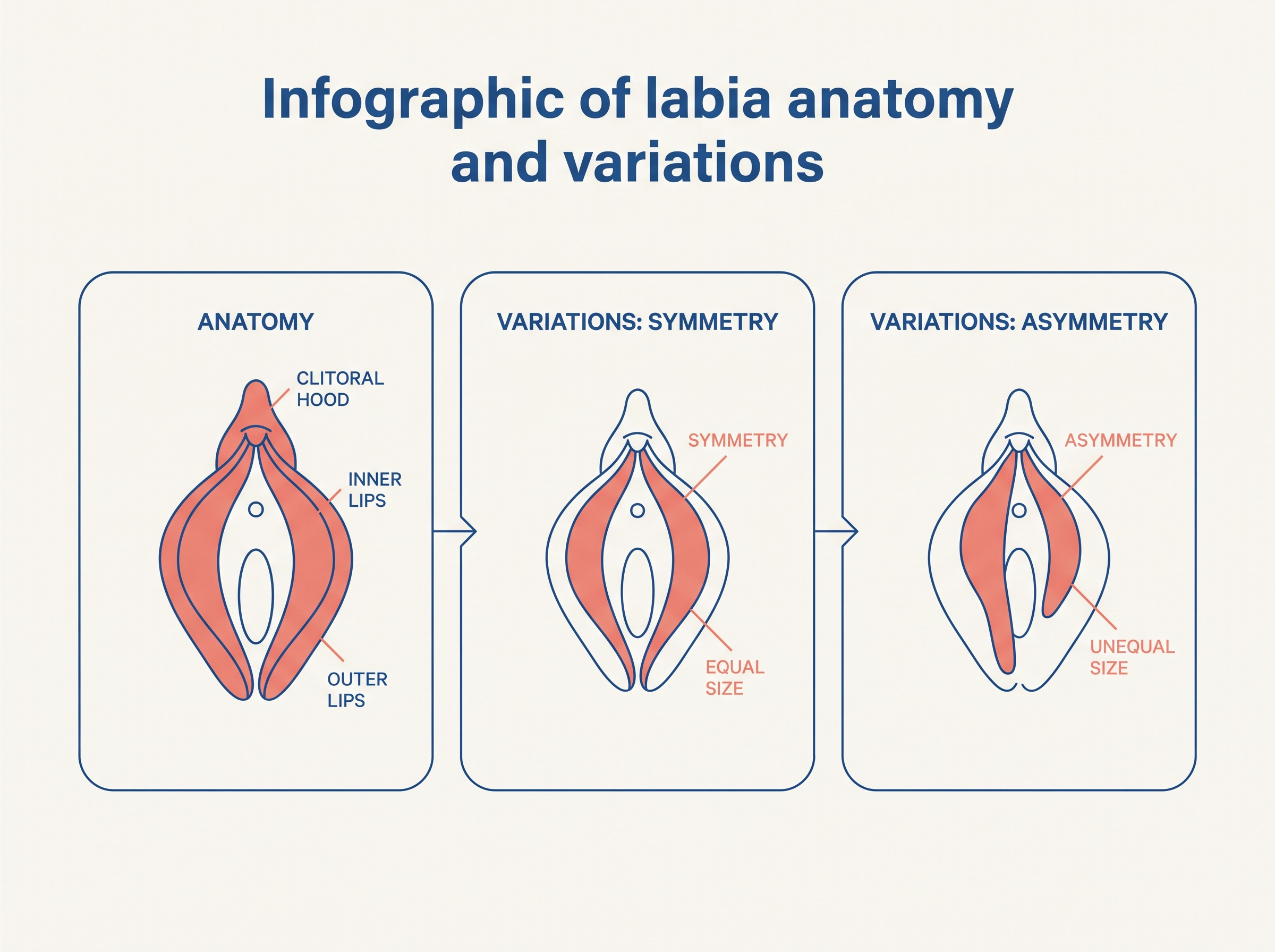
The labia are two sets of skin folds that form part of the vulva — the external female genitalia. The outer folds, called the labia majora, are thicker and padded with fat tissue. They run from the mons pubis (the soft mound above the pubic bone) down to the perineum. The inner folds, the labia minora, sit inside the labia majora and frame the vaginal opening and urethra.
Most anatomy diagrams show a single "standard" vulva, but that version doesn't exist in the real world. The labia minora can be almost invisible or extend well past the labia majora. They can be symmetric, asymmetric, smooth, ruffled, pigmented, or pale. None of these variations indicate dysfunction or pathology — they're just different shapes the same anatomy takes.
The Structure of the Labia Minora
The labia minora are thinner than the labia majora and contain minimal subcutaneous fat. They're richly innervated along their entire edge, which makes them important for sexual arousal. At the top, they split and form the clitoral hood (prepuce), which covers and protects the clitoris. At the bottom, they taper and may merge with the labia majora or remain distinct.
The space between the two labia minora is called the vestibule. It contains the urethral opening and the vaginal introitus (the vaginal opening). The aesthetics and function of the labia minora are tied to the vestibule's size and shape — two people with the same labia minora width can look completely different if their vestibule proportions differ.
How Much Variation Is Normal?
A meta-analysis of studies including 991 women documented extreme interindividual variability in labia minora size, shape, and pigmentation. Many women with protruding or asymmetric labia minora were completely asymptomatic, showing that protrusion isn't linked to physical discomfort. The wide dispersion of measurements confirms what most anatomy education skips: there is no single "correct" labia shape.
Interestingly, labia minora tend to be smaller in postmenopausal women than in premenopausal women — yet labiaplasty is often marketed as a "rejuvenation" procedure, which doesn't track with the actual biology.
What the Labia Do
Beyond their role in sexual arousal, the labia majora and minora protect the vaginal and urethral openings from friction, infection, and debris. The labia majora contain sebaceous glands that produce natural oils, and both sets of labia help maintain the vulva's microbiome and pH balance. They're not decorative — they're functional tissue doing a specific job.
The idea that labia should look a certain way to be "healthy" is a cultural invention, not a medical one. Classical medical literature offers very limited representation of vulvar morphological diversity, and most textbooks depict the vulva with minimal variation. The imbalance between abundant data on male genitalia and the scarcity of information on vulvar anatomy has only recently started to shift.
Tips for Embracing Your Labia
Here's the thing: most people never see enough real-world examples to know what normal actually looks like. Textbooks show one version, porn shows another, and neither reflects the range you'll find in actual human bodies. If you've ever wondered whether your labia are "too" anything — too long, too dark, too asymmetric — the answer is almost always no.
Understand That Variation Is the Norm
Labia minora can be nearly invisible or extend well beyond the labia majora. They can be symmetric or wildly asymmetric. One side might be darker, thicker, or longer than the other. Research confirms that this variability is completely normal and unrelated to function or health. Many women with protruding or asymmetric labia report zero physical discomfort — protrusion doesn't predict problems.
The wide range isn't a bug; it's how bodies work. Age, weight, and genetics all play a role, but there's no single "correct" configuration.
Seek Out Realistic Education
Most genital education materials are limited and don't reflect morphological diversity. If you're comparing yourself to a single diagram or a curated image set, you're working with incomplete data. Look for resources that show a broad spectrum of real anatomy — not idealized versions. Realistic, visually inclusive education supports healthy body image and helps you understand that what you see in the mirror is likely well within the normal range.
Know When Discomfort Is Worth Addressing
Most variation is asymptomatic. But if you experience genuine physical discomfort — pain during intercourse, irritation from tight clothing, or chafing that disrupts daily life — that's worth discussing with a healthcare provider. Discomfort isn't the same as insecurity, and it's a legitimate reason to explore options. Labiaplasty, for example, has high satisfaction rates and low complication rates when performed for functional reasons, not purely cosmetic ones.
The key is distinguishing between "I don't like how this looks" and "this is causing me actual physical problems." One is a body-image issue; the other is a medical concern.
Reframe the Conversation
Your labia are part of a richly innervated system designed for sexual arousal and pleasure. They're not decorative. They're functional, sensitive, and variable by design. If you've spent time worrying about whether they're "normal," redirect that energy toward understanding what they actually do and why that matters more than how they compare to anyone else's.
Body positivity isn't about pretending every part of your anatomy is your favorite. It's about recognizing that variation is expected, that function trumps appearance, and that the vast majority of what you might consider "abnormal" is actually just... normal.
Conclusion
The labia are a normal, functional part of vulvar anatomy — and they come in every shape, size, color, and degree of symmetry imaginable. If there's one thing the research makes clear, it's that variation is the norm, not the exception. Most of what we've been conditioned to think of as "unusual" is actually just normal human anatomy doing its thing.
Here's what matters: protruding labia aren't a medical problem, asymmetry isn't a defect, and the idea that labia need to look a certain way to be "correct" is a marketing story, not a biological one. Many women with labia that protrude beyond the labia majora report zero physical discomfort — the assumption that size equals dysfunction doesn't hold up in the data.
Understanding your own anatomy isn't about memorizing diagrams or hitting some imaginary standard. It's about recognizing that your body is one data point in a massive, messy, beautiful range — and that range is what's normal. The more we talk about it, the less power those airbrushed, one-size-fits-all images have.
If you're looking to explore what feels good for your anatomy, check out our guide to clit stimulators — because pleasure starts with knowing what you're working with, and then finding what works for you.