
Clitoris Diagram: Clear Anatomical Illustration & Explanation
Explore our detailed Clitoris Diagram with clear anatomical illustrations and explanations for better understanding of this essential female anatomy structure.
 Zoe Clarke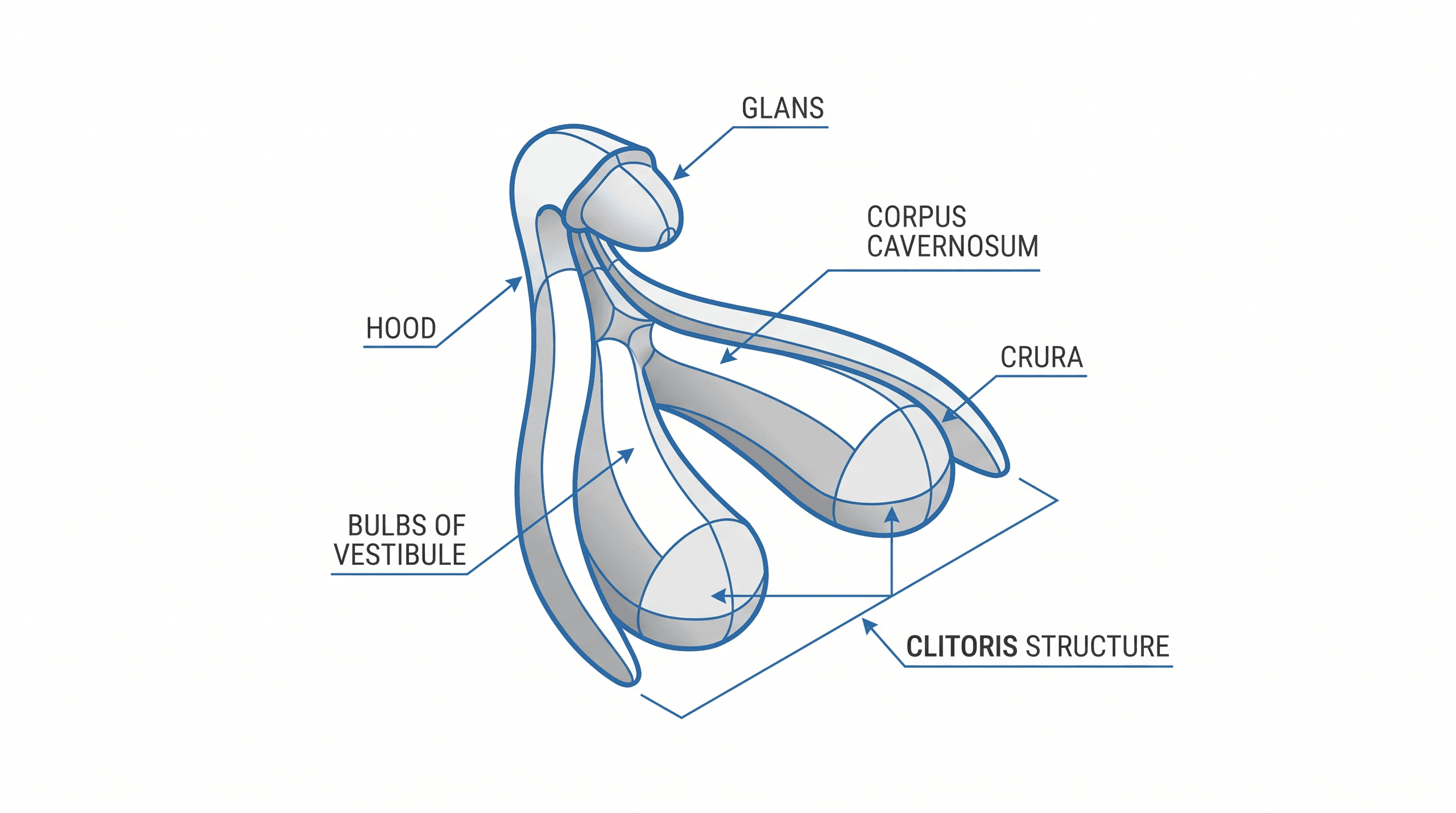
Introduction
A clitoris diagram is an anatomical illustration showing both the external glans and the internal wishbone-shaped structure that extends several inches inside the body. The clitoris is the most misunderstood organ in human anatomy. Not because it's complicated — because until recently, nobody bothered to map it correctly. While the penis was accurately described as early as 35 BCE, the full clitoral structure wasn't documented until 2005. That's not ancient history. That's the year YouTube launched.
Most people think the clitoris is just the small visible bump at the top of the vulva. That's the glans — the tip of an iceberg-shaped organ that extends several inches internally, with roots, bulbs, and a shaft that wraps around the vaginal opening. The clitoris diagram most sex-ed classes show you is missing about 90% of the structure.
This matters for one reason: pleasure. The clitoris has over 10,000 nerve endings and a nerve density markedly higher than the penis. It's not a "mini penis" or a secondary feature — it's the anatomical center of vulvar pleasure, and understanding how it's actually built changes how you approach stimulation. Whether you're shopping for a clit sucker or just trying to figure out why some angles work better than others, knowing what's happening under the surface makes the difference between guessing and actually knowing.
This guide walks through the full anatomical structure, breaks down the parts most diagrams leave out, and explains why the external glans is just the beginning. No fluff, no metaphors about flowers — just the actual anatomy and what it does.
Why Understanding the Clitoris Matters
The clitoris didn't get a full anatomical description until 2005. Not 1905 — 2005. The same year YouTube launched. That's how long it took for anyone to map out the entire structure of an organ that half the population has.
Most sex ed skips it entirely, or treats it like a footnote. The result is predictable: people who own one often don't know what it looks like, where it goes, or how it works. And people who don't own one definitely don't know. This isn't a niche anatomy problem — it's a knowledge gap that shows up in bedrooms, doctor's offices, and research labs.
The Research Gap Is Real
Scientific studies have focused overwhelmingly on male anatomy. The penis has been described in medical texts since 35 BCE. The clitoris? Barely mentioned until the 21st century. That imbalance means conditions like clitoral pain or orgasm disorders are less studied, less understood, and less likely to get clinical attention than their male counterparts.
When researchers finally started mapping clitoral innervation and structure, they found something striking: the clitoris has fewer total nerve fibers than the penis, but a much higher density of them. That's the kind of detail that matters — and it took until recently to document it.
Why the Gap Exists
Part of it is visibility. The clitoris is mostly internal — what you see externally is just the glans, the tip of a much larger structure. The rest is hidden, which made it easy to ignore in early anatomical studies. Part of it is cultural squeamishness around female pleasure. And part of it is just inertia: once a research focus gets established, it's hard to shift.
The practical fallout is that most people — including many healthcare providers — don't have a clear mental model of what the clitoris is or how it functions. That gap shows up when choosing toys, when describing sensation, and when trying to figure out what's normal. If you're looking for a guide to clitoral anatomy and function, you're already ahead of most people.
The clitoris was fully mapped in 2005 — the same year as YouTube.
How to Read a Clitoris Diagram: Anatomical Breakdown
Most clitoris diagrams show you the glans — that visible nub at the top of the vulva — and call it a day. That's like showing someone the tip of an iceberg and pretending the rest doesn't exist. The clitoris is actually a multi-part structure, most of which sits inside the body, and understanding the full layout changes how you think about what works and why.
External Components: What You Can See
The external clitoris has three parts: the glans, the prepuce (clitoral hood), and the frenulum. The glans is the visible tip — the part that gets all the attention in diagrams and conversations. It's covered by the prepuce, a fold of skin that protects it when you're not actively doing something with it. The frenulum is the small band of tissue connecting the glans to the hood. These are the only parts you can see without a scalpel, which is why most people think that's the whole story.
Internal Components: The Wishbone Structure
The internal clitoris looks like a wishbone. The clitoral body extends from the glans and splits into two crura (legs), which attach to the pubic bone on either side. Between those crura sit the vestibular bulbs — paired erectile tissue that circles the vaginal opening and sits just under the labia minora. The bulbs are covered by the bulbospongiosus muscles, which run from the perineal body to the clitoris. When aroused, all of this tissue fills with blood, which is why the entire vulva can feel more sensitive during arousal — it's not just the glans doing the work.
Nerve Density and Sensitivity
The clitoris has fewer total nerve fibers than the penis — about 60% lower in absolute count — but the innervation density is markedly higher. That means the nerves are packed more tightly into a smaller area, which is why even light touch on the glans can feel intense. The clitoris also has a higher proportion of myelinated fibers, which transmit signals faster. This is the anatomical reason why clit stimulators work so efficiently — they're targeting one of the most densely innervated structures in the human body.
Why the Full Structure Matters
Understanding the internal components explains why some stimulation feels indirect but still works. Pressure on the vestibular bulbs, stimulation along the crura, or internal pressure from penetration can all activate parts of the clitoral structure that aren't visible. The wishbone shape means the clitoris wraps around the vaginal canal, which is why "vaginal orgasms" and "clitoral orgasms" aren't actually separate categories — it's the same structure being stimulated from different angles.
What Should a Good Clitoris Diagram Include?
The clitoris doesn't come with a manual, and most of what people learn about it is either wrong or incomplete. If you're trying to understand how it actually works — whether for your own body or someone else's — here's what actually helps.
Start with the anatomy, not the technique
Most guides jump straight to "what to do," but that's backwards. Understanding the structure — the glans, the shaft, the bulbs, the crura — gives you a mental map that makes everything else make sense. When you know where the internal structures are, you stop guessing and start working with what's actually there.
For a complete anatomical study of the clitoris, scans should be obtained in all three dimensions: transverse, coronal, and sagittal. That's medical-speak for "you need to see it from multiple angles to get the full picture." Diagrams that only show the external glans miss about 90% of the organ.
Use reputable medical sources, not random blogs
The internet is full of clitoral "facts" that are either outdated or flat-out wrong. Stick to sources that cite actual research — medical journals, anatomy textbooks, and educational sites run by sexual health organizations. If a site doesn't list its sources or uses vague language, skip it.
Clitoral adhesions can cause pain, difficulties with arousal, and orgasmic dysfunction — which is why understanding normal anatomy matters. If something feels off, you need accurate information to know whether it's variation or a medical issue worth addressing.
Look for interactive resources, not just static diagrams
Static diagrams are useful, but interactive 3D models let you rotate, zoom, and see how the structures connect. Some anatomy apps and educational sites offer clitoral models that show the full internal structure, which is hard to visualize from a single flat image.
Don't skip the history
Understanding why the clitoris was ignored for so long — and how recent most of our knowledge actually is — gives context to why so much misinformation still exists. The full anatomy wasn't mapped until the late 1990s. That's not ancient history; that's recent enough that most current sex education curricula still don't include it.
Conclusion
The clitoris isn't complicated — it's just been treated that way for most of recorded history. Until 2005, medical textbooks didn't even have the full anatomical description right. That's not ancient history; that's last decade.
Understanding the structure — the glans, the shaft, the crura, the bulbs — changes how you think about pleasure, how you shop for toys, and how you talk about what works. Most clitoral vibrators are designed around the external glans because that's the part everyone knows. But the internal structures matter just as much, especially when you're choosing between a pinpoint bullet and a broader air-pulse toy.
The clitoris diagram isn't just an illustration. It's the baseline for making informed decisions about your own body and the products designed for it. The more people understand the actual anatomy, the less room there is for vague marketing and the 'just try everything' approach that wastes money and time.
Female anatomy education has been historically neglected — not just in textbooks, but in product design, medical research, and everyday conversation. That gap is closing, but it closes faster when more people know what they're looking at.