
How to Choose an Anal Vibrator Safely: Materials & Features
Discover how to choose an anal vibrator safely with our guide covering body-safe materials, flared bases, and features for first-time buyers.
 Zoe Clarke
Introduction
The first time someone in my group chat sent me a TikTok about anal vibrators with the caption "is this safe," I realized how many misconceptions are floating around. Most guides lump all vibrators together without addressing the unique safety considerations that matter when you're shopping for anal use. Features like a flared base aren't optional — they're the difference between a good experience and an ER visit.
Anal vibrators are designed differently than other beginner sex toys for a reason. The anatomy is unforgiving, the stakes are higher, and the internet is full of advice that ranges from vague to actively dangerous. If you've spent any time scrolling product pages, you've probably noticed that some toys are mislabeled or marketed as "multi-use" when they're missing critical safety features.
This guide covers what actually matters when you're choosing an anal vibrator: the materials that won't cause problems, the shapes that work for beginners, and the features that separate safe products from risky ones. Whether you're buying your first toy or upgrading from something that never felt quite right, the goal is the same — figure out what works without wasting money on products that don't.
What Makes Anal Vibrators Different
Anal vibrators aren't just regular vibrators with a different label. The design requirements are specific because the rectum doesn't have the same natural "stopping point" that the vagina does. That means every anal toy needs a wide base or handle that physically cannot be pulled inside — no exceptions, no "I'll be careful," no hoping for the best.
Size and shape matter more here than they do for clitoral or internal vaginal toys. Beginners often assume they need something small and tapered, which is half-right — but the taper needs to lead to a bulb or ridge that provides stimulation, not just a smooth stick that does nothing. Motor placement is the other thing most first-time buyers miss: a motor at the tip feels different than one at the base, and for anal use, tip-focused vibration tends to be more effective.
Understanding the Importance of Safe Selection
Anal vibrators aren't like other toys — the stakes are different, and what works for clitoral or vaginal use doesn't automatically translate. The anatomy here doesn't have the same natural barriers, which means a toy that's fine elsewhere can become a safety issue if it doesn't have the right features. Most first-time buyers don't realize this until they're staring at a product page wondering why half the reviews mention emergency room visits.
The biggest risk is losing the toy internally. It sounds dramatic, but it's the reason every single guide on anal toys hammers the same point: flared base, no exceptions. The rectal canal doesn't stop at a fixed depth the way the vaginal canal does — it keeps going, and muscle contractions can pull an object further in. A flared base acts as an anchor, keeping the toy outside your body no matter what happens during use. If a vibrator doesn't have one, it's not an anal toy, even if the marketing says otherwise.
Material choice matters more here than with most other toy categories. Porous materials like jelly rubber, TPE, or "skin-safe" blends can harbor bacteria even after cleaning, and the rectal lining is more vulnerable to infection than vaginal tissue. Body-safe materials — silicone, ABS plastic, stainless steel, borosilicate glass — are non-porous, which means they can actually be sterilized. Cheap toys skip this because body-safe materials cost more to manufacture, but this is the one place where you don't want to cheap out.
Why Beginners Get It Wrong
Most people buy their first anal vibrator the same way they buy a bullet vibe: they sort by price, pick something under $20, and hope for the best. That works fine for a basic clitoral toy, but anal products at that price point are almost always made with unsafe materials or missing critical design features. The other common mistake is assuming that "small" automatically means "beginner-friendly." Size matters, but a thin toy with a narrow base is more dangerous than a slightly thicker one with proper anchoring.
Another trap: multi-use products marketed as "for anywhere." A dual-motor vibrator that's shaped like a standard dildo might technically fit, but if it doesn't have a flared base, it's not safe for anal use no matter what the product description implies. If you're not sure whether a product is actually designed for this, check whether the retailer lists it under "anal toys" or just "vibrators" — and when in doubt, look for dedicated anal-specific designs rather than trying to repurpose something else.
Steps to Choose an Anal Vibrator Safely
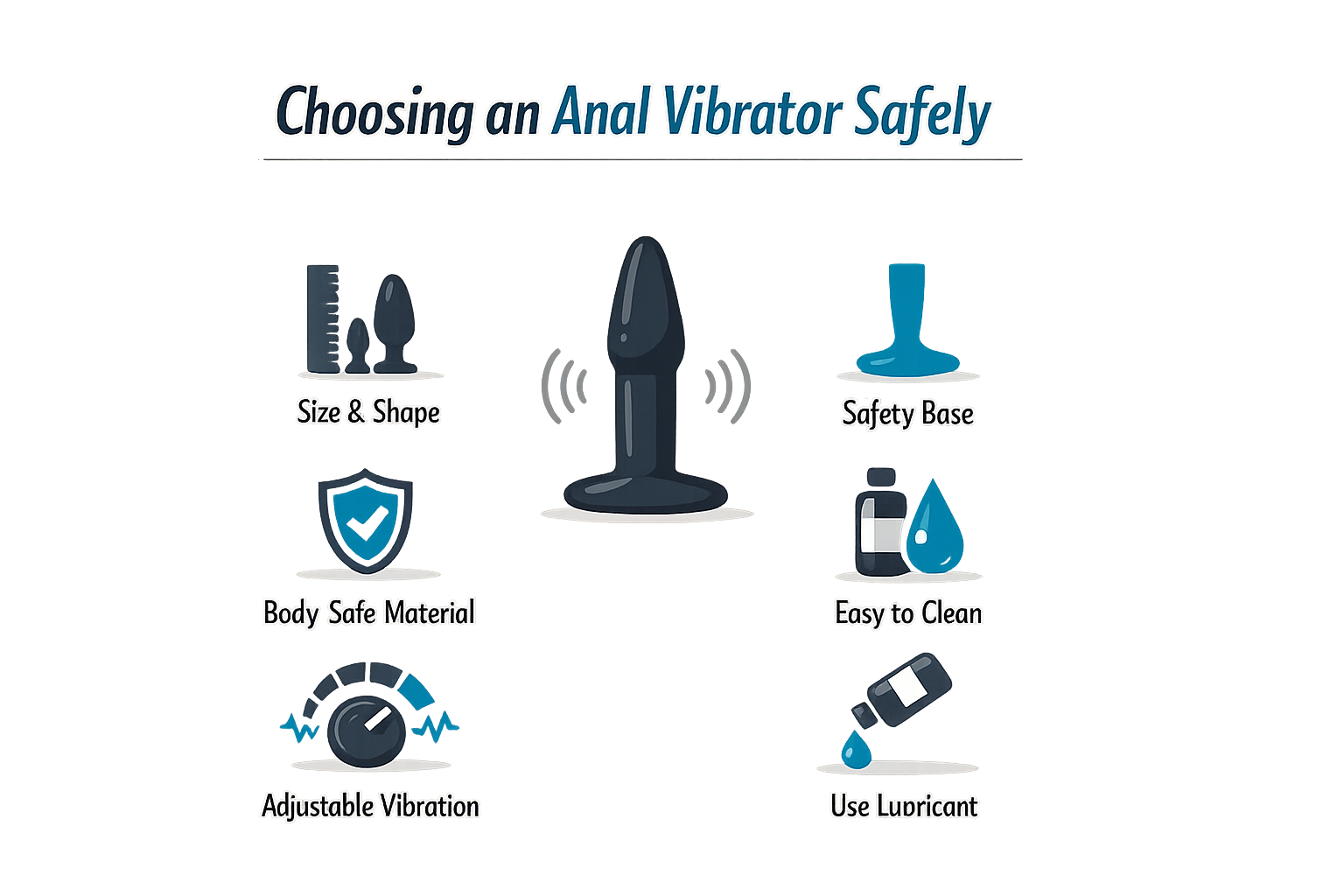
Choosing an anal vibrator doesn't need to feel overwhelming. The process boils down to a few non-negotiable safety features and then personal preference. Here's the actual checklist.
Step 1: Verify the Base Is Flared
Step 1
Check for a flared base
Before you look at anything else — vibration patterns, color, price — confirm the toy has a wide, flared base or handle. This is the single most important safety feature. The base must be significantly wider than the widest part of the insertable shaft. If it's not, the toy can get lost internally, which means an ER visit. No exceptions.
If the product page doesn't show a clear photo of the base, skip it. Retailers sometimes mislabel plugs as vibrators or show glamour shots that hide the base structure. You need to see it.
Step 2: Confirm Body-Safe Materials
Step 2
Choose silicone, glass, or stainless steel
Stick to 100% silicone, borosilicate glass, or stainless steel. These are non-porous, which means bacteria can't hide in microscopic cracks. Silicone is the most common and the most forgiving for beginners — it has some flex, warms to body temperature, and is easy to clean.
Avoid anything labeled "jelly," "TPE," "TPR," or "realistic skin." These materials are porous, can't be fully sterilized, and often contain phthalates. If the product description doesn't list the material clearly, assume it's not body-safe.
Step 3: Start Small and Tapered
Step 3
Pick a beginner-friendly size
For first-time buyers, look for toys with a tapered tip and a maximum diameter under 1.25 inches. A gradual taper makes insertion easier and gives you control. You can always size up later; you can't undo discomfort from starting too big.
Length matters less than girth. Most people don't need more than 4–5 inches of insertable length, especially when starting out. The "bigger is better" assumption doesn't apply here.
Step 4: Choose Vibration Strength and Pattern
Once safety is locked in, think about what kind of stimulation you want. Do you prefer steady, consistent vibration or varied patterns? Some toys offer rumbly, deep vibrations; others are buzzier and more surface-level.
Rechargeable toys tend to have stronger motors than battery-operated ones, but they also cost more. If you're not sure this is for you yet, a $25–$35 battery-powered option is a reasonable test run.
Step 5: Check Waterproofing and Cleaning Requirements
Anal toys need to be cleaned thoroughly after every use. Waterproof toys (labeled IPX7 or higher) can be fully submerged and are easier to sanitize. If a toy isn't waterproof, you'll need to clean it carefully with a damp cloth and toy cleaner, which is doable but less convenient.
Silicone toys can be boiled for sterilization (as long as there's no motor). Glass and stainless steel can go in the dishwasher. If ease of cleaning matters to you — and it should — prioritize waterproof silicone.
Step 6: Buy from a Reputable Retailer
This isn't the category to buy from Amazon third-party sellers or random drop-ship sites. Counterfeit toys, mislabeled materials, and missing safety certifications are common. Stick to known names: Lovehoney, Ella Paradis, Spectrum Boutique, Peepshow Toys, or manufacturer-direct sites.
If you're comparing prices and one retailer is 40% cheaper than everyone else, there's a reason. It's either a knockoff or a return someone else sent back.
The cheapest option isn't the one that saves you money if it's not safe to use.
For more guidance on getting started with toys in general, check out How to Use Sex Toys: A Beginner's Practical Guide.
Tips and Tricks for First-Time Buyers
Buying your first anal vibrator shouldn't feel like navigating a minefield, but a lot of first-time buyers overcomplicate it. Here's what actually matters when you're starting out — and what you can ignore until you know what you like.
Start Smaller Than You Think
Most beginners buy something too big. The toys that look "reasonable" online are usually larger than you need, and the ones marketed as "beginner" are often still ambitious. Look for something with an insertable length under 4 inches and a diameter around 1 inch or less. You can always size up later — you can't make a too-large toy smaller once it arrives.
Prioritize Simple Controls for Your First Pick
Your first anal vibrator doesn't need twelve vibration patterns or app connectivity. Single-button controls or a simple dial are easier to manage when you're learning what you like. Complicated remotes and multi-function modes sound appealing in theory, but they're a distraction when you're trying to focus on sensation. Save the feature-loaded picks for round two.
Don't Cheap Out on Materials
This is the one place where budget picks can backfire. Body-safe silicone costs more than jelly rubber or PVC, but it's non-negotiable for anal use. Porous materials harbor bacteria even after cleaning, and that's a risk you don't want to take. If a toy is under $20 and doesn't explicitly state "100% silicone" or "medical-grade silicone," it's probably not safe. Spend the extra $10-15 — your body will thank you.
The cheapest option isn't always the budget-friendly option when you factor in replacement costs and potential health risks.
Check the Flared Base Before You Buy
This one sounds obvious, but it's easy to miss when you're scrolling through product photos. The flared base needs to be significantly wider than the insertable shaft — at least 1.5 times the diameter. A lot of "beginner-friendly" toys have bases that are barely wider than the body, and that's not safe. If the base looks like it could slip past your sphincter in the product images, keep scrolling.
Lube Is Part of the Purchase, Not an Afterthought
You need water-based lube for silicone toys, and you need more of it than you think. Plan to buy a dedicated bottle (at least 4 oz) when you order your vibrator. Silicone-based lube will degrade silicone toys over time, and oil-based options are messy and harder to clean up. Water-based is the safe default — it's compatible with all materials and easy to wash off. For a broader introduction to using toys safely and effectively, check out our guide on how to use sex toys.
Read the Cleaning Instructions Before You Commit
Some anal vibrators are fully waterproof and can be boiled or run through the dishwasher. Others are splash-proof at best and require careful hand-washing around the battery compartment. If the product page doesn't specify the IPX rating or cleaning method, that's a red flag. Toys that are hard to clean properly are toys you won't use consistently — and inconsistent cleaning is a health risk.
Ignore the Reviews That Mention Other Uses
A lot of anal vibrator reviews will say things like "works great for clitoral stimulation too!" That's fine, but it's not what you're shopping for. Focus on reviews that specifically mention anal use, comfort during insertion, and whether the base stayed secure. General-purpose feedback won't help you assess whether a toy is right for this specific use case.
Don't Overthink Your First Purchase
Your first anal vibrator is a learning tool, not a forever commitment. You're figuring out what size feels comfortable, what vibration strength works for you, and whether you prefer internal stimulation or something that stays more external. It's okay if your first pick isn't perfect — most people end up with a small collection because preferences shift as you get more experience. Start with something simple, body-safe, and appropriately sized, and you'll have a much better baseline for what to try next.
Conclusion
Choosing an anal vibrator safely comes down to three non-negotiables: a flared base, body-safe materials, and features that match your experience level. The flared base keeps the toy from disappearing internally — that's not a horror story, that's just anatomy. Body-safe silicone, glass, or stainless steel mean you're not introducing porous materials or mystery plastics into a sensitive area. And starting with something smaller, slower, and designed for beginners means you're not white-knuckling through an experience that should feel good.
The internet is full of mislabeled products and guides that treat all vibrators the same. They're not. Anal vibrators have specific design requirements that clitoral or G-spot toys don't share, and skipping those features because a product looks cute or went viral is how people end up with regrets — or worse, in the ER. When I was deep in Lovehoney's clearance section for the third hour, I noticed that some products are mislabeled, which can be a real issue if you're not sure what to look for. The good news is that once you know what to prioritize, the category is straightforward.
If you're still figuring out what works for your body, our guide to beginner sex toys covers the broader landscape of first-time-friendly picks. But for anal specifically: trust the flared base, trust the material, and trust that starting small is the smart move. The rest is just marketing.